Red Koigu KPPPM Cardigan

It’s Fibre Friday again, and time to peek in on my knitting projects. Progress on my Wingspan shawl came to shuddering halt this week, when I realized I would run out of yarn. You might remember that I went up a needle size and wondered if I’d run out. Well, I will. So, I stopped knitting and ordered another skein of the same yarn – it’s Briar Rose Fibers Sea Pearl. The yarn is 50% merino and 50% tencel, and has a lovely sheen. I didn’t think that mixing in another yarn even for the border would look right.

The colour and dye lot aren’t marked on mine and it’s been aging in the stash for so long that there’s no way the colour would match anyway. I had a look at their website and think mine might be colour 1841. (It’s also possible that it’s a colour they don’t dye anymore.) I ordered a skein of 1901 (it’s on the second page of colour samples) which is a grey. It looks quite similar to mine but without the pink, which should make the hem look a bit darker. And the grey is probably the same dye.

While that project is on hold, I wanted to knit something other than socks. I had another poke through my needle stash and found a pair of 3.5mm circulars. Yay! They’re only 60 cm long, but that’s plenty for a cardigan knit in pieces. You know what happened next – I cast on the Lunenberg Cardigan in my red Koigu.

Here’s what it looks like so far:

Lunenberg Cardigan by Andrea Hungerford knit in Koigu KPPPM by Deborah CookeIt’s interesting how pink this shot looks on my computer. The yarn is actually a gorgeous variegated cherry red and I just love it.

The colour number is 329. I had a look at the colours on Koigu’s site, and it looks even more vividly pink there. It looks more like #859 on this page.

This cardigan is knit top down but in pieces – this is the back from the shoulders down. I have a few more inches to go before doing the ribbing (which will give me time to decide whether to knit ribbing or another edge) but I’m very happy with how it’s coming out.

What do you think?
Pretty Little Shawl

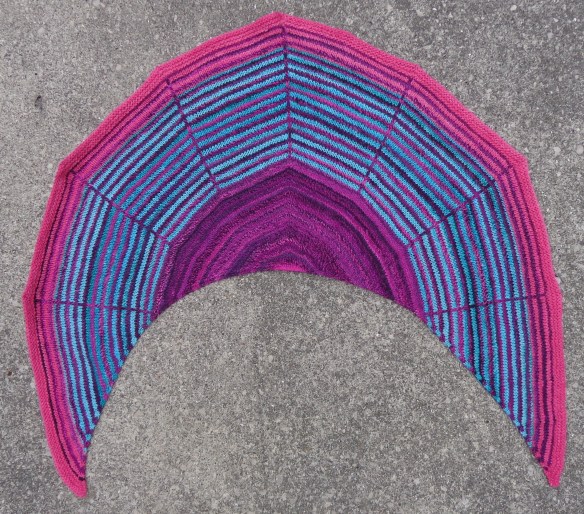
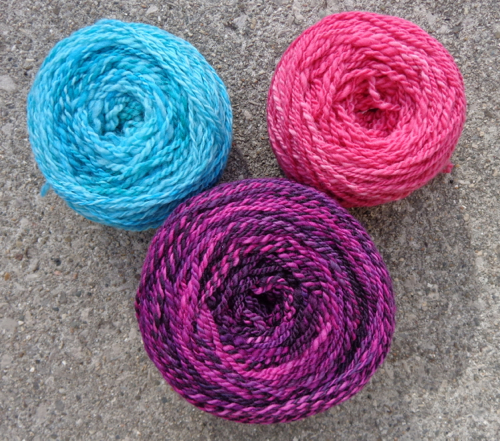
Last year, at the readers’ conference Romancing the Capital, Carol gave me some of her beautiful merino handspun. She’d dyed it, too, and I spent a lot of time looking at the (very soft!) yarn, trying to figure out how to show it off.handspun marl

I finally decided on a pattern called Daybreak by Stephen West. It’s written for fingering weight yarn and this was heavier, so I just winged it. I started with the purple, then striped in the turquoise. When I ran out of purple, I switched to the pink, then did the edging in pink when the turquoise was gone.  I’m very happy with how it came out:Daybreak shawl by Stephen Wesst knit in handspun by Deborah Cooke

It’s just the perfect size to sit over the shoulders and falls to my elbows. I love shawls of this size as they keep my back warm but stay out the way.

The pattern was great and I’ll definitely knit another.

I’m heading to RTC again next week, and I’m going to wear the shawl. I’m hoping that Carol will be there.

What do you think?

Waiting for Rain Shawl

This week, I finished knitting a shawl. These are unusual colours for me, but I really like the result.

The pattern is called Waiting for Rain (that’s a Ravelry link) and it features lace inserts in a garter stitch crescent-shaped shawl. The construction is really interesting, plus it’s easy to play with the colours and the design.

I knit mine in Madeline Tosh Dandelion, which has 10% flax. It’s interesting because the different fibers take the color in different ways. I used two skeins of Chickory and one of Whiskey Barrel. I decided to do the lace inserts in Whiskey Barrel, as well as some extra stripes and the bind-off. This yarn is discontinued so it’s gone from the MadTosh website, but here’s a Ravelry link.

This meant that I had too much yarn – the pattern calls for 700 to 800 yds, and I had over 900 – but I wanted to use it up. The pattern has three lace inserts. Once I’d followed the directions, I continued in a similar way and added two more lace inserts, then knit in garter stitch until the Chickory was gone. I liked the yarn. It’s smooth and cool, and I like the colour gradations in each colourway. There were long fibres, presumably of flax, and it was tempting to tug them out but I knitted them in. The pattern was well-written and clear. I bought the collection and will knit another shawl from it.

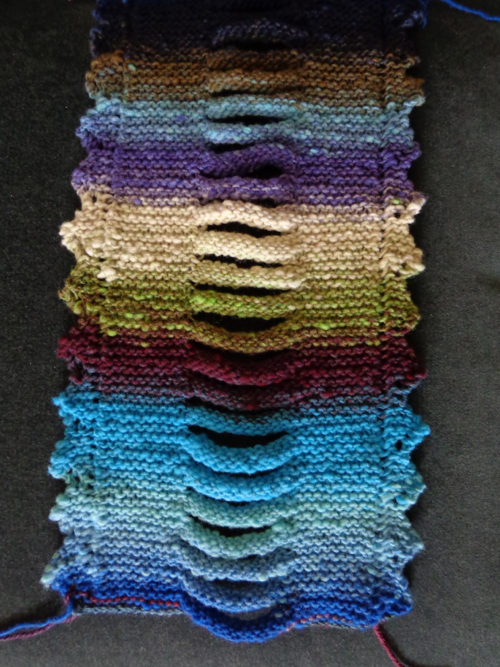
Here’s a detail shot, showing off the yarn:

Waiting for Rain shawl knit in MadTosh Dandelion by Deborah Cooke

There are stripes in the Whiskey Barrel, but the Chickory has some of the same greyed brown tone in it so it’s hard to tell which yarn is where. I like that! If you’re curious though, all the garter stitch below the lowest lace insert is in Chickory, then the bind-off is in Whiskey Barrel. You can just barely see it. Also, the garter stitch is all Chicory down to the first lace insert. (The shawl is knit from the top of the picture.)

My only disappointment is that I wasn’t sure how much Whiskey Barrel to leave for the cast-off, and I left too much. 😦 That means leftovers for the stash, about 8g. It turns out that I could have knit a couple of rows of garter stitch in the contrasting colour before casting off, but that’s how it is and that’s how it will stay. There’s no need to frog back a 500 stitch cast-off!

Here’s the complete shawl:

Waiting for Rain shawl knit in MadTosh Dandelion by Deborah Cooke

I was debating whether to block this shawl. I don’t usually block garter stitch shawls because I like the squishy texture they have right off the needles. It’ll get bigger if it’s blocked, though, and I was thinking it’s just a nice size. While taking the pictures, though, I can see that the ripple on the increasing edge is too much. I’ll give it a good block it this weekend.

What do you think?

Another Undine

I started this stripey shawl almost a year ago. It’s my own Undine pattern, but with a modification (and a correction). I blogged several times already about this one: Knitting for a Mermaid, Progress on the Mermaid Shawl, More Progress on the Mermaid Shawl, and The Mermaid Shawl Puzzle. It’s been a bit of a process, and I won’t review all my revelations and corrections again today.

It’s done!

variation of Undine by Deborah Cooke knit in Crazy Zauberball sock yarn by Deborah Cooke

It’s knit of Crazy Zauberball, which is a self-striping sock yarn, and I started with two balls. I alternated two rows from each ball. I thought I did some clever calculations to finish the shawl with two balls, but there was an error in my calculations. I needed 2.7 balls to finish.

variation of Undine by Deborah Cooke knit in Crazy Zauberball sock yarn by Deborah Cooke

I love how the stripes came out, and the ruffled edge. I’m not going to block this one – I don’t usually block shawls knit in garter stitch because I like the springiness of them – so once the ends are sewn in, it’s ready to wear!

My Ravelry project page for this one is right here.

What do you think?

Noro Braided Cowl

There’s a great cowl in the newest Noro magazine, which I’ve just knitted. The technique is so clever!.

The newest Noro magazine is issue 7 – you can see a preview of the designs on the NoroMagazine website, right here. The pattern is #16 and is called Braided Scarf (that’s a Ravelry link.) It’s supposed to be knit in Noro Silk Garden, but I’ve used Noro Kureopatora – since my yarn is a little lighter, I’ve also dropped the needle size. Mine came out a bit narrower than the one in the magazine – it’s 6 inches wide – but that’s okay by me.

The scarf is knitted with a picot edge on either side and crosswise slits – every so many rows, you cast off the middle stitches, then cast them on again in the next row. Like this, it reminds me of spinach pastries a local bakery made in our old neighbourhood – they slit the top of the pastry like this so it vented. 🙂

Braided Scarf by Jacqueline van Dillen knit in Noro Kureopatera by Deborah CookeBut then, here’s the cool bit. You pull the piece together a bit, turning those strips into loops, and link them together to make a braid down the middle of the cowl. Here it is after it’s braided:Braided Scarf by Jacqueline van Dillen knit in Noro Kureopatera by Deborah CookeIsn’t that brilliant? I keep braiding it and unbraiding it, just to see the magic happen.
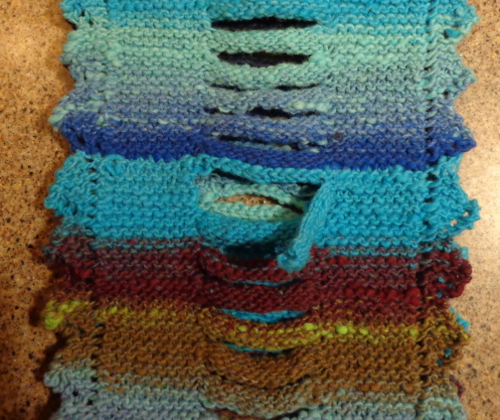
I did a provisional cast on, and grafted the cowl into a loop when it was completed to avoid having a seam. I also wanted the braid to be continuous. The instructions say to braid the middle of the finished cowl, then tack down the last loop. I wanted it to hook around the first loop. The only way to do that (which I could see) was to break the loop, like this:

Braided Scarf by Jacqueline van Dillen knit in Noro Kureopatera by Deborah CookeThis is the cowl grafted together – you can see that the colours didn’t match up. (Boo. I had a knot in the ball, otherwise it might have come out perfectly.) I ended with the bright turquoise and had started with the ultramarine blue. The line where they meet is the line of the graft. The first loop, then, is turquoise on the bottom half and ultramarine on the top half. The loop before that, though, is broken. I did this by casting on the stitches in Row 5 of the pattern, then turning, leaving the last 15 stitches of that row on the other needle, unworked. I worked on the front part of the row through Row 11, then left it on the right needle after the cast-on stitches. I worked the intervening rows on those left stitches that had been waiting on me, then finished Row 11. At the end of that repeat (Row 12) I grafted the two edges together.

So, I had a broken loop. When I braided it all up, I tucked that loop around the first loop, then sewed it down from the back, as if it had been joined up all along. The finished braid looks like this:

Braided Scarf by Jacqueline van Dillen knit in Noro Kureopatera by Deborah CookeNo one can ever unbraid it again. 🙂

I’m very happy with this one. What do you think?

Stripey Noro Scarf

I also finished a Stripey Noro scarf. It doesn’t really have a pattern: I just cast on in Noro Silk Garden, knit alternating rows in garter stitch. Mr. Math has grabbed his one. I just love it, so I might grab it back once in a while.Stripey scarf knit in Noro Silk Garden by Deborah CookeHere’s a shot in different lighting while it was still on the needles:
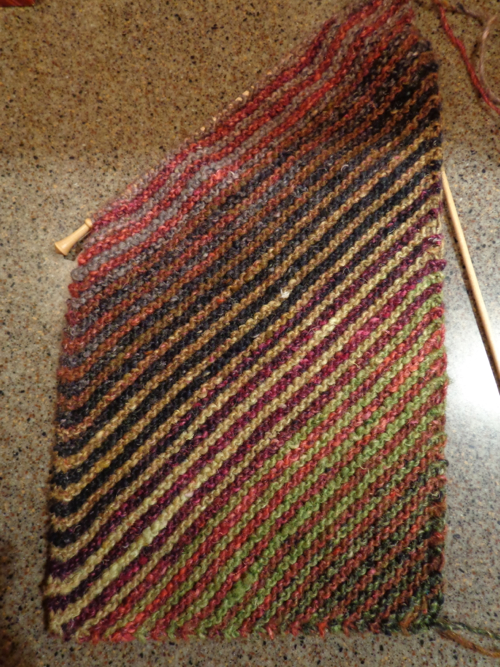
Stripey scarf knit in Noro Silk Garden by Deborah CookeI cast on in the corner, then added a stitch at each end of each right side row until I decided it was wide enough. From that point onward, I increased a stitch on the right side row at one edge and decreased a stitch on the right side row at the other edge. I kept knitting until it looked long enough, then decreased one stitch at both the beginning and the end of each right side row until there were no stitches left. Presto! The gradient stripe of the Noro Silk Garden makes the magic happen.

Storm on Exmoor

I’ve been thinking about winter this past week. I’m not sure why, as it hasn’t been that cold, but I’ve been making plans for staying warm. I bought a new hat, for example, and it has ear flaps. I also knit this cape-cowl, out of Kidsilk Haze Trio from the stash:Storm on Exmoor by Sara's Texture Crafts knit in Kidsilk Haze Trio by Deborah CookeYou might remember that I made a sweater of this yarn a while back. This cowl was made from two of the leftover balls of wool. It’s light and warm, nestles over my shoulders and rises in squishy goodness to cuddle under my chin.

The pattern is called Storm on Exmoor and it’s free. (That’s a Rav link.) The designer suggests wearing the capelet as a topper outside a coat on a chilly day, but I wanted a big cowl to wear inside my coat, to keep my throat and chest warm. (This may be a Canadian vs. a UK perspective.) I modified the pattern a bit, working the body in stockinette stitch instead of garter, the hem in garter instead of ribbing, and continued the cowl until I ran out of yarn. I figured stockinette stitch will sit flatter inside my coat than garter stitch would and I wanted the neck as high as possible.

I just love how this came out, and how warm it is. I can knot a scarf over or under the neckline, or just wear it as it is. It’ll be just the thing this winter.

Plus the pattern is really nice, a quick and easy knit with room for variation. I may be making more of these for Christmas presents, in different yarns.

How do you plan to stay warm this winter?

The Mermaid Shawl Puzzle

The Mermaid Shawl has had me puzzled. Last week, I figured out what was going on. Even though I’m using my own pattern, Undine, I didn’t follow the directions. In Undine, the ruffle is created with short rows at the outer edge of the shawl, and this ruffle remains the same width across the shawl. Any changes to the total width of the shawl are made in the body of it, right before the ruffle. (The increases are between the ruffle and the main part of the shawl.) This means that the rows in the body of the shawl are perpendicular to the lead edge, like this:Undine by Deborah Cooke knit in Noro Kureyon Sock by Deborah CookeWhen I began to knit the Mermaid Shawl, though, I didn’t read my own directions! I made my increases at the lead edge (i.e. the beginning of the right side row). This skewed the knit rows. Because of the location of the increase stitch, the rows fall at an angle to the lead edge, like this:Undine shawl by Deborah Cooke knit in Crazy Zauberball by Deborah CookeThe gussets that make the ruffles don’t appear to be in a separate band either. They just flow from the main shawl – in a way that would definitely please a mermaid.

This is pretty interesting. I had no idea this would happen. I would have expected my mistake to make very little difference. I was wrong about that!

If I had just continued, following the rest of the directions for Undine, the stripes would have been at an angle for the entire shawl. But, I had decided to make an inverted V in the back, again with short rows, to emulate the shawl in the Jane Eyre movie. The finished V looks like this:Undine shawl by Deborah Cooke knit in Crazy Zauberball by Deborah Cooke

My revised plan had been for the inverted V to be the middle of the shawl, BUT the knitting still doesn’t line up. In fact, it’s only this new part that is perpendicular to the lead edge, and that means that the picture above is actually the midpoint of the shawl.

I need to knit another inverted V of short rows before decreasing to the end of the shawl to make the shape come out right. The finished shawl will have three triangles. This means that I’ll run out of yarn – I’m half done, but have only 30% of my yarn left. I’m going to have to buy a third ball to finish. I do like it, though, and it will bug me if I don’t finish it so that the rows are straight.

What do you think?

More Progress on the Mermaid Shawl

I’ve been knitting and thought it time to show you my progress on that stripey shawl.Undine shawl by Deborah Cooke knit in Crazy Zauberball by Deborah CookeI’m just past the midpoint. I made a variation to the pattern on a whim. I decided to do some short rows in the middle, so there will be an inverted V down the centre back. This will make the shawl narrower but will also give it a slightly different shape. I worked two stitches less for every second row from about the lime stripey bit until I got down to just a few more stitches than the godets require. (There are more details on my Ravelry project page.)

Look at the ruffled edge at the top and you can see the green godet which is the middle point of the shawl. (It’s the top green godet.) From that point, I’ve been adding back two stitches every second row and will continue until I’m working all of the stitches again. Once there, I’ll carry on with the decreases in the pattern to finish the shawl.

I’ll show you another picture of the turns once I’ve made more progress and you can see the inverted V more clearly. I’m quite happy with this one. What do you think?

Progress on the Mermaid Shawl

I thought I’d show you my progress on my Undine striped shawl today. I really like what the self-striping yarn is doing:Undine shawl by Deborah Cooke knit in Crazy Zauberball by Deborah CookeYou can also see how the hem is beginning to flutter. If I held that top edge (the one on the right) straight, it would ripple even more.

I’ll start to decrease the width of the shawl once I’ve used half of the yarn. The easiest way to determine that point is to weigh the balls of yarn. (I use the kitchen scale.) They were each 100g when I started. Now they’re both around 75g. When they get to 52 g or so, I’ll start to decrease. I want to make sure the shawl is symmetrical, so might do something different at the midpoint. We’ll see when I get there.

In the meantime, what do you think?