Spector is a pattern by Joji Locatelli, a top-down pullover with some stitch detail on the yoke. It also uses four different colours to create a gradient. The pattern is designed to use Madeline Tosh Merino Light and for once, I’m using the specified yarn.
Here are my choices for the gradient. The colourways, from right to left, are Spicewood, Saffron, Simmer Pot and Red Phoenix.  That Simmer Pot is really something and the photograph doesn’t do it justice. I bought it on a whim. Here’s the page on Ravelry that shows it in stashes – because many Ravellers are much better photographers than I am. (I don’t see the colourway on the MadTosh website.)
And here’s the beginning of my yoke. I’ve started the first gradient change and am supposed to split the yoke for the sleeves. I’ve put it on a thread to try it on first, which is the wonderful opportunity of knitting top-down sweaters.
 It seems that this sweater is supposed to tug down, to make a scoop neck. When I tried it on at this point, it seems too soon to split for the sleeves as it’s challenging to tug it down enough for it to reach my underarms. My gauge is spot-on. On Ravelry, people have commented on how stretchy it is and how well it fits. Hmm. I’m small in the shoulders, so this should work. Hmm. I decided to knit a litte more before splitting for the underarms, since I prefer more of a round neck and I dislike tight sweaters. I ended up knitting another 3/4″.
I’d just started the change to the second colour in this picture and you can see a teeny bit of it at the bottom of the yoke. I did the first round of bud stitches incorrectly, just below the ribbing for the neck, but I did them consistently 🙂 so I’m not going to frog back.
When the yoke is split for the underarms, there’s a neat little trick to turn the work inside out, so the body is mostly knit instead of mostly purled. I’m not doing that, as I don’t mind purling and I think there might be a gauge difference.
I also did some recalculations for dividing the body and sleeves because the pattern warns that the rib stitch might not line up. Of course, I want it to so I made some changes. I’m making the L or the fourth size. Instead of beginning the division at the marker, I worked 2 stitches first (P2), then put 66 stitches on a holder instead of 68. I cast on 6 stitches, placed a marker, then cast on 6 more. (This is two repeats of the ribbing pattern. The instructions are to cast on 7 PM and co 7 more.) Then I worked 125 for the front instead of 122, put 66 on a holder, cast on 6 stitches, placed a marker, then cast on 6 more. I worked to the end of the row, then removed the end-of-row marker and worked to the middle of the underarm in pattern. That’s the new beginning of the round.
Because I was in the middle of a colour transition, I alternated between the two colours from the old marker to the new one, then continued in the specified transition.
Instead of 68-122-28-102, I ended up dividing my stitches 66-125-66-103 for the sleeve-front-sleeve-back. With 12 sts cast on at each underarm instead of 14, my total stitch count is still 252, as the pattern specifies. Ha.
Now, it’s TV knitting. Onward!
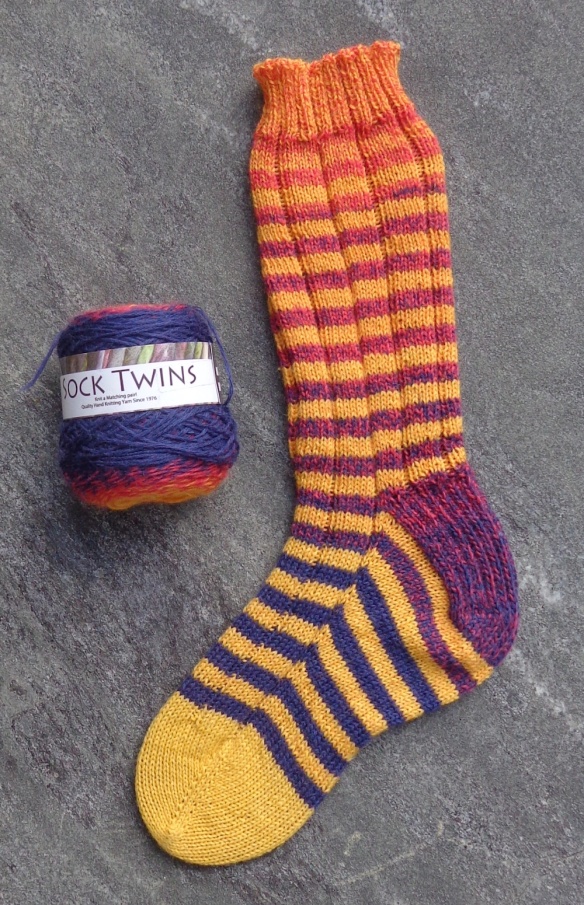 I knit them toe-up because I wanted to use up all the yarn in the gradient. This time I used the
 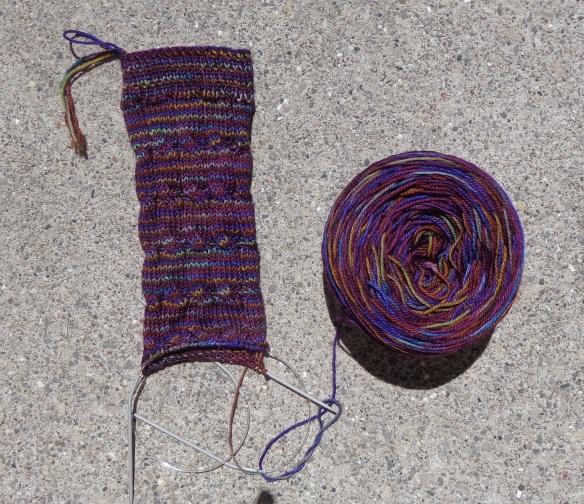 I’m just doing my usual sock thing, casting on 72 stitches, working 72 rows, turning the heel etc. This time I did 6×2 ribbing and added a cable twist every 12th row. It makes the counting easier to the heel, although I hadn’t planned it that way. I just wanted to mix it up a bit.
 When I finished my
 There was a little bit of yarn left so I made a hat.
 This pattern is called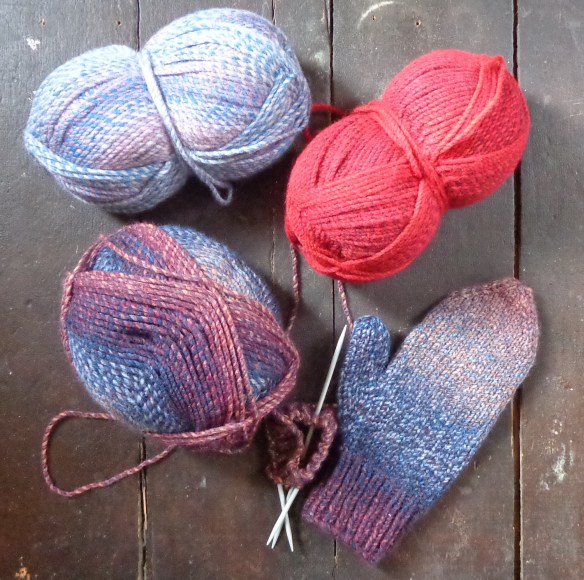
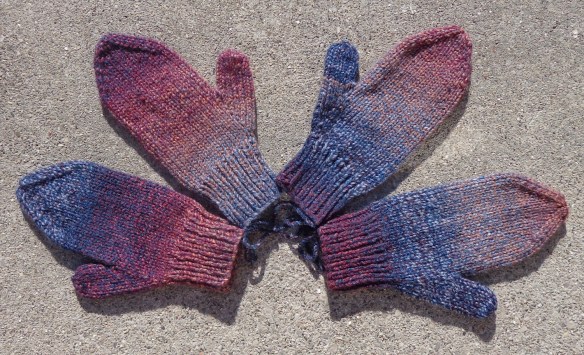 The repeat on the colour was longer than the amount of yarn needed for one ball. I just knit the four, then matched them up the best I could.
 It’s interesting how the mitts matched more easily, even though this was the smaller size. The repeat on the gradation must be shorter in this colourway.
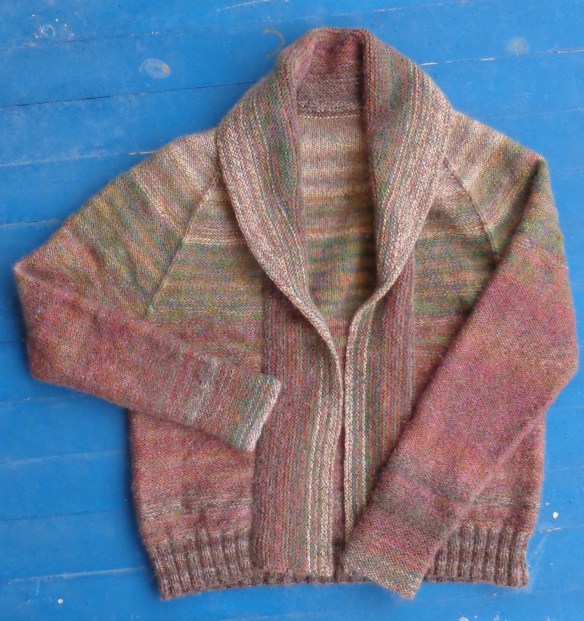 I’ve worn this a fair bit. It is odd that it doesn’t have a front fastening, although I’m sure I could add one. I do think I mucked up the sleeve decreases as they’re narrow – fine for wearing but less fine for pushing up to the elbow as I’m inclined to do with my sweaters. They’re also a bit long for me. And I know that I somehow did too many short rows on the collar: it’s quite substantial! That makes it snuggly, though – and is one of the hazards of knitting anything other than plain rows while watching tv.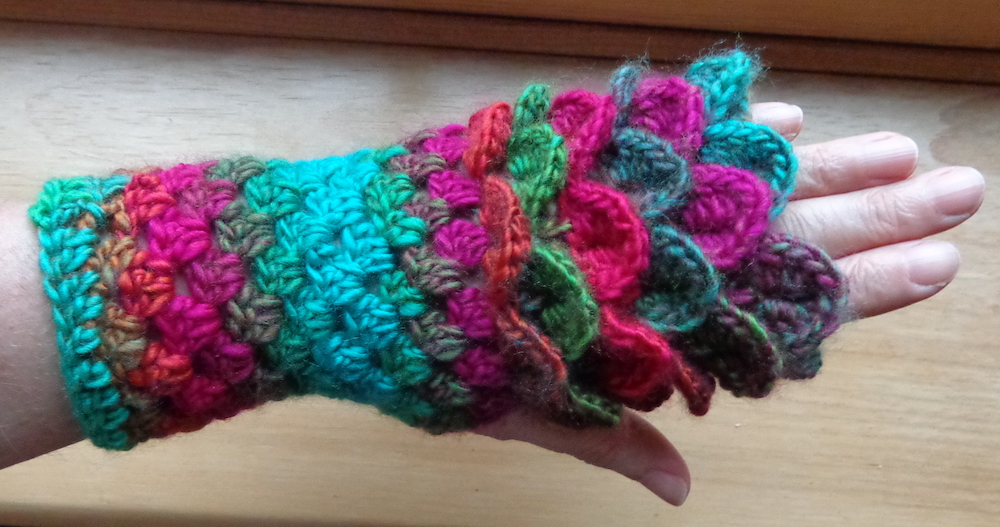

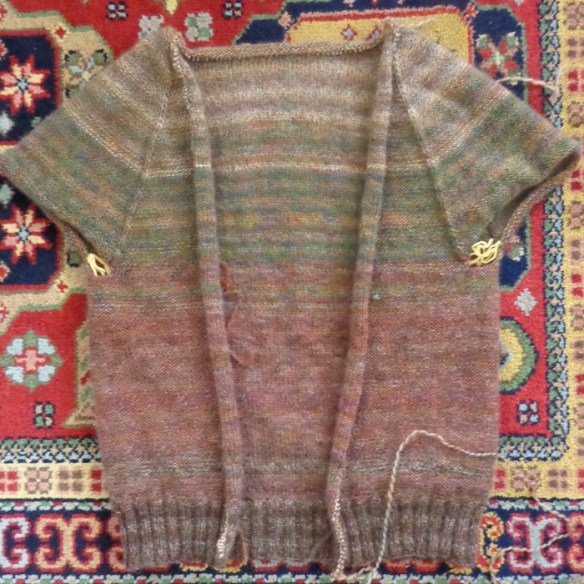 I picked up the stitches to do the neck next (before the sleeves) to manage my yarn. I didn’t have enough of all the colourways, so decided to do the neck, then use half of whatever was left for each sleeve.
 I did decide to frog and reverse the order of the colourways on the collar, picking up with my last colour, which is the brown. It blends in better and looks neater. See?
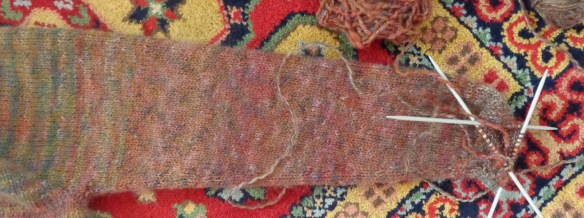

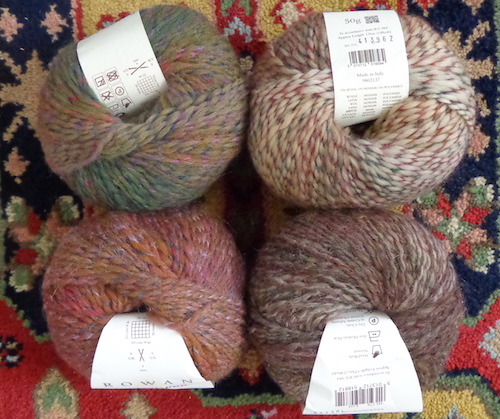 For this project, I raided my stash and chose my leftovers of Rowan Colourspun. I had knitted Mr. Math a vest in this yarn, then bought more to make myself a sweater when it was discontinued. Here’s
 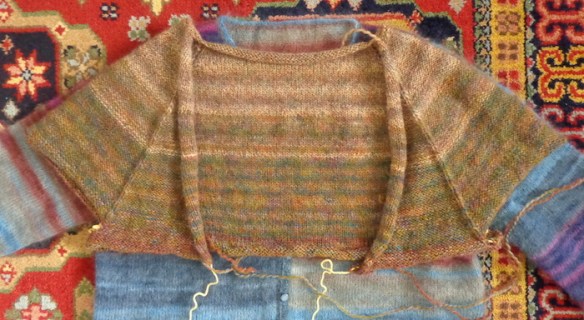 Here’s the cardigan as of last Sunday. I’d just divided for the arms. You can see that the ribbing for the neckline has a good bit of space to fill – this sweater is designed to be worn open, so the fronts with the ribbing will just meet. It’s also designed so that the purl side is worn out, which makes it look even more blended.

 This is the edging from the pattern. It’s a nice shell stitch, which fits perfectly with the waves.
 Alive & Knitting