More Comfort Knitting

I haven’t knit a shawl in a while, lace or otherwise – well, I’m still plugging along on my Water shawl, but it’s not a very fun knit at this point. I don’t think it counts anymore. 🙂

A LYS had Freia Handpaints yarns on sale, and I simply can’t resist gradient dyed yarns. I ordered some and cast on.

I chose a pattern by BooKnits. I wanted to knit a lace shawl with some beads and I had The Close to You Collection of patterns already. (That’s a Ravelry link.) I had knit Snow Angel from this pattern collection, also in Freia Handpaints yarn, but in their Wool/Nylon Lace which is discontinued. The colourway was Autumn Rose.

Here’s my Ravelry project page for the project.

And here’s that Snow Angel shawl:

Snow Angel by Boo Knits knit by Deborah Cooke in Freia Ombre Wool/Nylon Lace

There’s a blog post for it, which is right here.

This time, I’ve chosen the pattern Heaven Scent, which is in that same collection but also available on its own. (That’s a Ravelry link.) I’m knitting the smallest size, with the stockinette stitch top.

This yarn is Freia Handpaints Ombré Shawl Ball Merino. The colourway is Vamp. Here’s the Ravelry yarn page.

Here’s my progress so far:

Heaven Scent shawl by BooKnits knit by Deborah Cooke in Freia Handpaints Ombré Shawl Ball Merino

The camera is really emphasizing that hot pink. The colourway ends in a bright red.

Of course, it’s curled on the circular needle in the opposite direction of its shape – the shawl will be a crescent curved the other way when it’s off the needles and blocked. (Much like Snow Angel, shown above.)

The yarn is a loose single ply. It’s very soft but tougher than expected – there is the usual thick-and-thin of single ply yarns but it hasn’t been splitty to knit and it hasn’t broken.

And here’s a detail view. I’m using 6/0 purple Czech glass beads in dark purple, which match the beginning of the gradient pretty well.

Heaven Scent shawl by BooKnits knit by Deborah Cooke in Freia Handpaints Ombré Shawl Ball Merino

I did make a slight change to the pattern. The shawl grows quickly in width because you add four stitches on every right side row and two on every wrong side row. The additions are at the beginning and the end of each row, and the pattern uses make-one (slanting left or right). I found that two M1s with just a knit stitch between them, then another M1 on the purl side pretty close by made for a tight edge. I switched out the two M1s on the purl side for YO’s, then the outer M1 on the right side rows to YO’s as well. I’m curious to see how this blocks out. It feels better to me.

I’m almost halfway through the second repeat of the main chart, then have the border chart to knit. I’m thinking I might run out of yarn (the pattern notes that 400m is close) so if I do, I’ll have to find something matchy to finish.
A Knitted Coat for Tyler

You might remember the knitted coat and hat I made for Barbie, using patterns from Sticka till Barbie. The pattern was #101 Yellow Coat along with the coordinating hat. That post is right here.

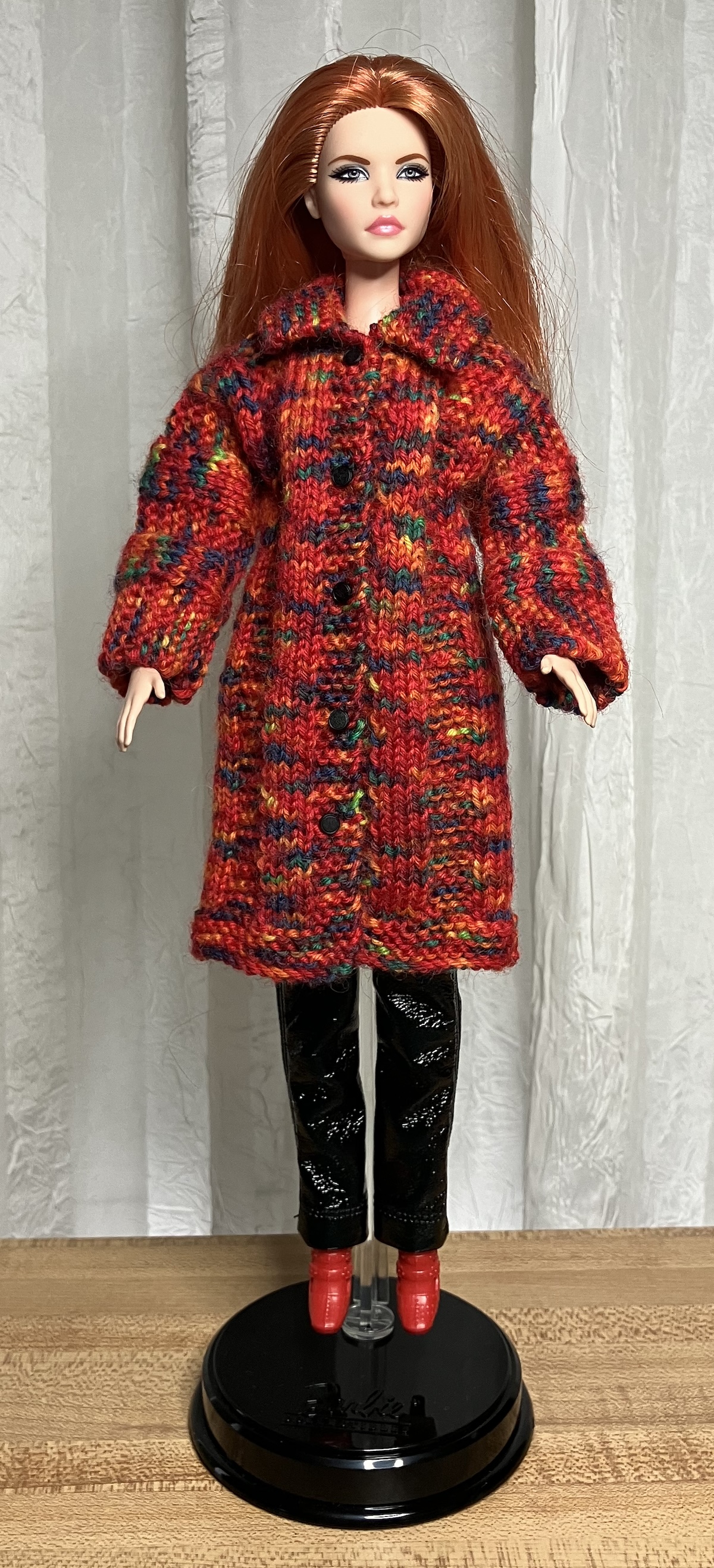
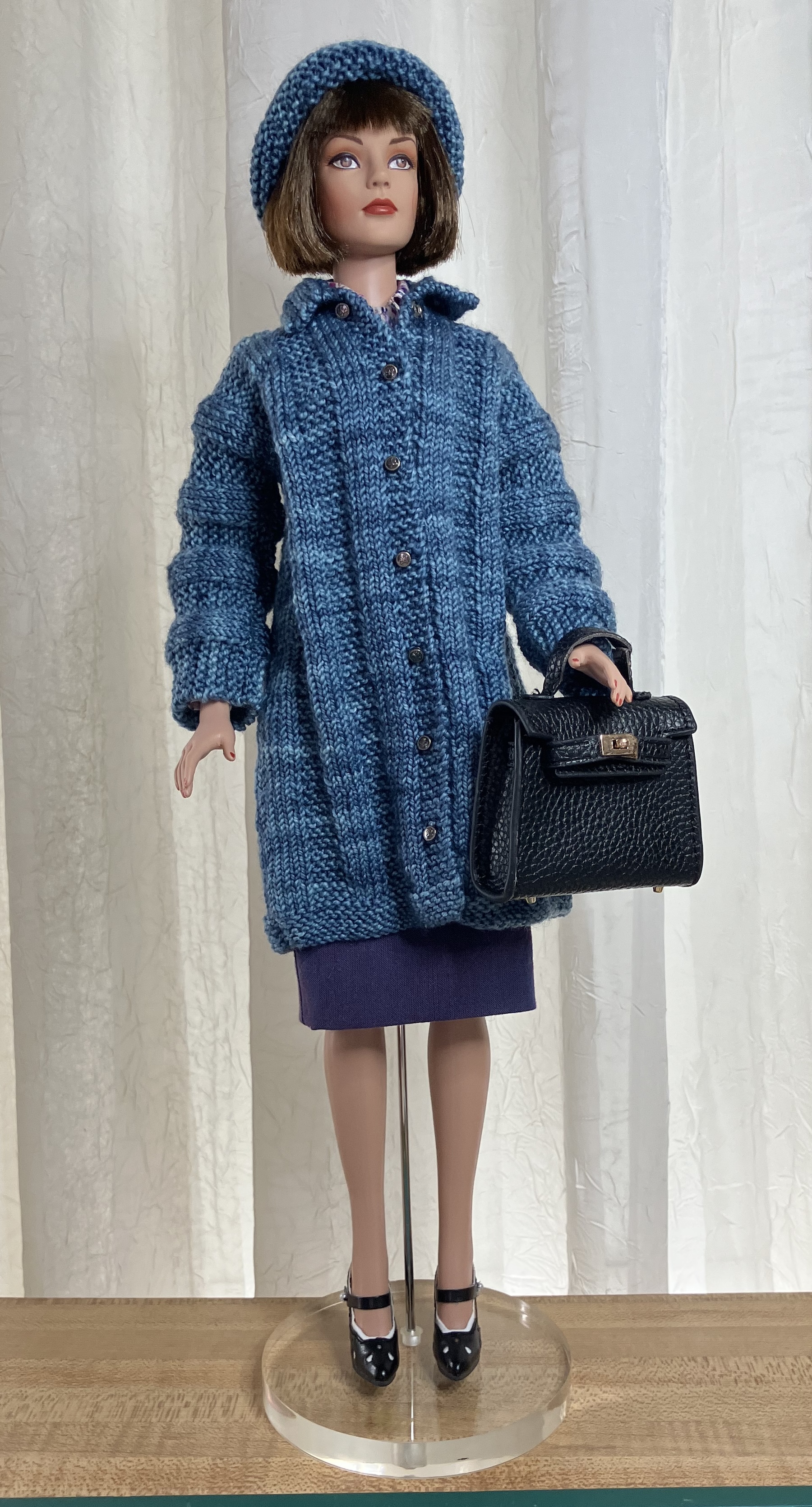
I decided to resize the pattern for my 16″ girls, and I think it came out pretty well. I used Koigu KPM and it took almost the entire 50g skein for the coat. Fortunately, I had another skein to make a matching hat.

This is Mosaic Modern Sydney Chase doing the honours today. I wish I had an umbrella to add to this combo. It has a bit of a retro look, and not just because of the shoes. (They are from a shoe pack, which included the pink slingbacks that Tyler is wearing in the picture below this one.)

Knit coat for Tyler Wentworth, knit from Koigu KPM by Deborah Cooke

The Koigu KPM has a kettle-dyed look, which worked out really well for this one. I was afraid a variegated or space-dyed yarn might pool – also Sydney says she can wear it with more things.

If I knit a second one, I might add pockets to the front. I thought of that this time, but wasn’t entirely certain what row they should be on. I’ll mark this one, just at her hand, then count the rows up from the front to know for next time.

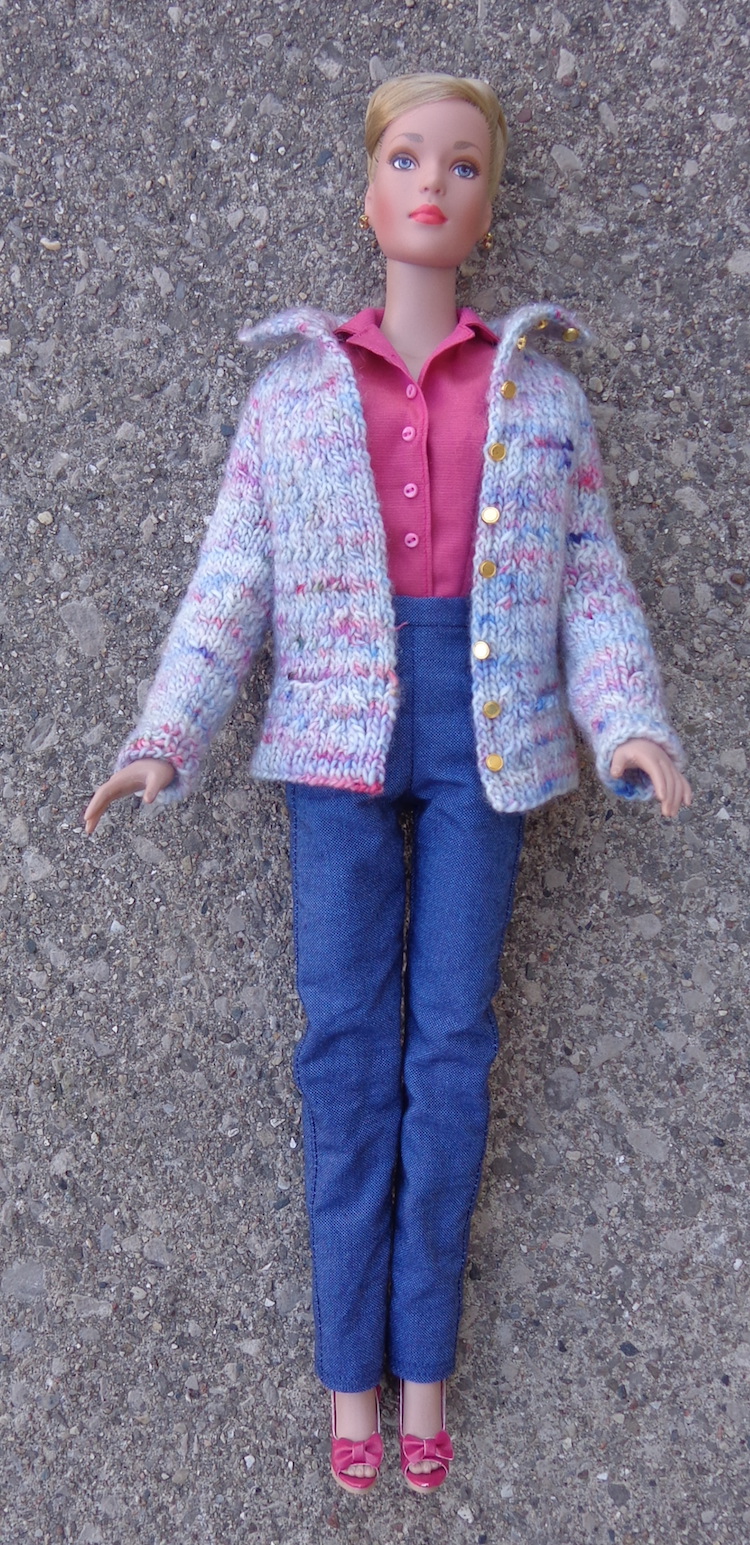
I would make them like the pockets in this cardigan – it’s hard to see the line of cast off stitches in each front but have a look. The pocket hangs inside, like a welt pocket without much of a welt. I can just slide the tip of my finger into it.

Cabled cardigan knit by Deborah Cooke for Tyler Wentworth

I also made Sydney a blouse and skirt to wear with this knitted coat. She looks like a librarian to me in this combo, thus the glasses and book.

Top and skirt sewn for Tyler Wentworth by Deborah Cooke

This is the blouse from McCalls 3701 (the same pattern used for the pink one above) which is actually a bodysuit. It’s made of Liberty Tana Lawn. Quite a clever little design, even if the collar is fussy fussy.

McCalls 3701
Fashion Doll Clothing by Rosemarie Ionker

The skirt is drawn from the basic skirt sloper in Rosemarie Ionker’s Fashion Doll Clothing. It’s made of Kaffe Fassett shot cotton and lined with Bemberg rayon.

And two more girls are on their way to me, NRFB and from an estate sale. I’ll show them to you when they arrive. 🙂

Comfort Knitting

As mentioned last week, I’ve been doing some comfort knitting. Besides making clothes for the girls, this usually means knitting socks and/or mittens. I also sorted some stash and rehomed a bunch of it, which meant I rediscovered some goodies, too.

The mittens are from one of these rediscoveries. They started with a bag of mill ends from Spinrite of Patons Rumor, a long discontinued yarn. Here it is on Ravelry. It’s a bulky weight yarn that’s mostly acrylic but also is 15% alpaca, which makes it very soft and a bit fuzzy.

This colourway, which is a light purple, is called Hibiscus Heather.

Mittens and scarf knit by Deborah Cooke in Patons Rumor

I first made a pair of mittens for myself, using the Tin Can Knits’ World’s Simplest Mittens pattern. (That’s a Ravelry link.) If you don’t have a basic mitten pattern, this is a really good one – and it’s free! It includes instructions for four sizes of mitten, each in four different weights of yarn. I used the chunky instructions for an adult small.

I also cast on a scarf for myself to match and am just making it up as I go. I’m really enjoying this knitting – it’s the combination of the yarn, which feels nice, and the Brittany birch needles, which I always love to use. This is about the midpoint. I’ll make nine diamonds, then taper down to the other point. Will it need a tassel on each end? Possibly…

A Knitted Coat for Barbie

Things have been a little quiet here, mostly because of real life. When things get busy and even a little unpredictable, I always choose some comfort knitting. Lately that’s been knitting for the girls, as well as mittens and socks. Today, we’ll look at my latest completed project for the girls.

This is another free pattern from Sticka till Barbie, this time for a knitted coat. It’s amazing that I’m always learning more about fitting clothes for the girls – this time, I learned that vintage Barbies have shorter arms than modern Barbies. MTM and Silkstone (articulated and original) all have longer arms than vintage B.

I knitted the first coat following the instructions for #101 Yellow Coat. Here’s a Ravelry link for the pattern. The original website was taken down in 2022. The wayback machine’s backup of the original site has changed now – previously you could download individual patterns from there. There is also this other backup at the Internet Archive. Scroll down for the link to download a zip file of all the patterns. I’d do this soon, as it seems the content is vanishing. There are so many clever patterns in this collection.

Here’s my first coat in Patons Kroy sock yarn, on a MTM doll.

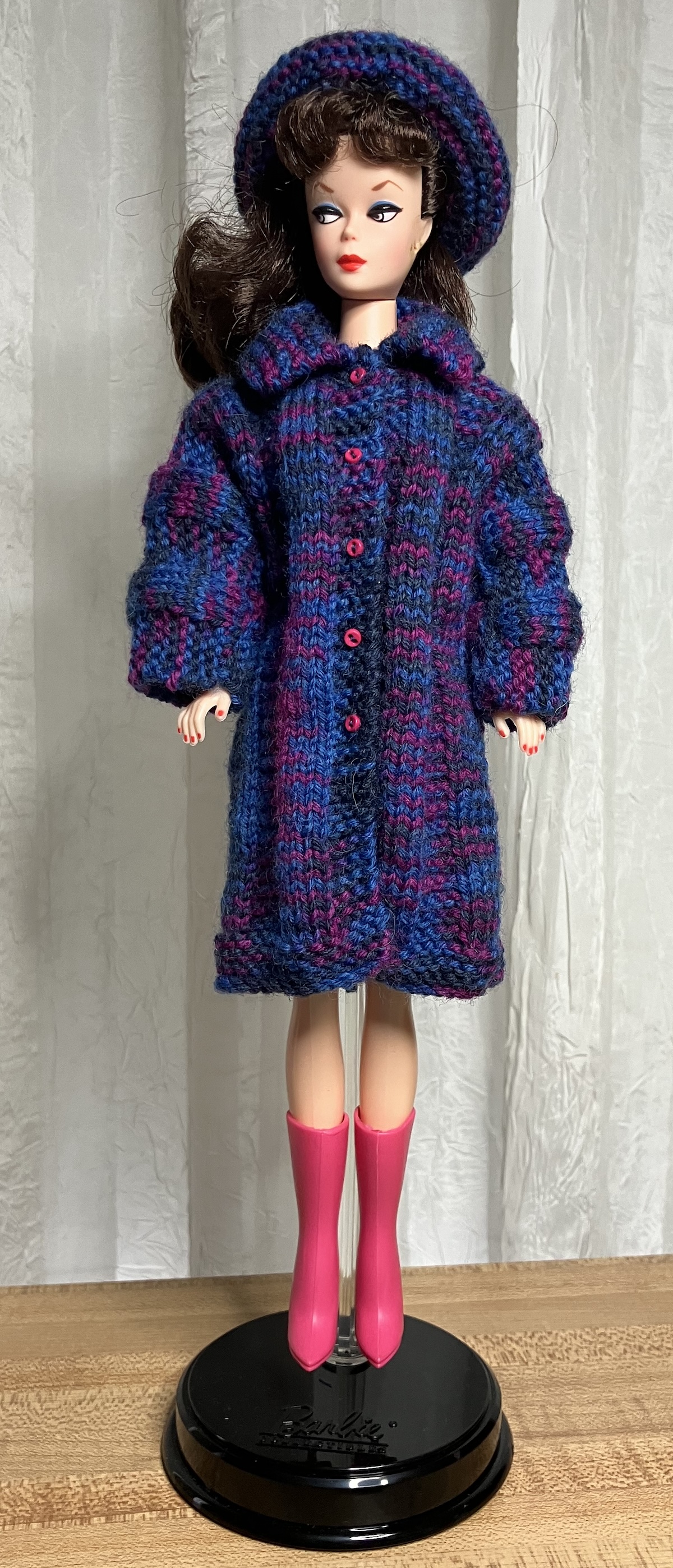
coat knitted for Barbie in Kroy sock yarn by Deborah Cooke

This coat is knit from the front hem up over the shoulder and down the back. You knit one front, then the other, then join them at the back collar line and knit down the back. The sleeves are added as you go – it’s shaped like a T, kind of like a kimono. Stitches are picked up at the neck for the collar.

This coat took 35g of Patons Kroy – I just barely made it with my partial ball of the red mix, so couldn’t make the hat shown with it in the pattern picture.

I cast on a second version and cast on two less stitches on each sleeve, to make shorter sleeves for vintage B. Here’s that one – this time, I had enough yarn for the hat, too.

coat and hat knitted for Barbie in Kroy sock yarn by Deborah Cooke

The hat is cute and quick to make. I joined mine in the round so there wouldn’t be a seam, although the instructions are to knit it flat. The hat pattern is A-41.

I’m working on a modification of the coat, resizing it for the 16″ girls. I’m knitting it in a kettle-dyed Koigu that is quite pretty. It’s amazing how much more knitting that requires, but I’m headed down the back now and should have it done soon.

Another Sticka-till-Barbie Dress

When you need a quick project, a doll garment can provide that almost-instant gratification – and a free pattern from Sticka-till-Barbie might be just the thing.

This is #87 Gold Dress. Here’s the pattern listing on Ravelry.

Here’s the Internet Archive backup of the Sticka till Barbie patterns. There is no longer the option of downloading individual patterns at the Wayback Machine, but the Internet Archive offers a zip file of the entire catalogue. I’d grab it now.

This is a straight dress knitted top down with ribbing at the waist. The original pattern is seamed down the back, but I joined the cast-on stitches in the round.

I think they allowed two stitches for the CB seam, as the first dress was a bit broad in the back for Barbie (who is bigger in the front than the back). I knit that first dress, then modified the pattern and knit the second. I liked it much better so I frogged the first and reknit it following the modified instructions.

This one fits vintage B best. The yarn is Koigu KPPPM and it used 10g on 2mm needles.

A dress knitted for vintage Barbie in Koigu KPPPM by Deborah Cooke

My modifications:
Instead of casting on 52 and knitting flat, I cast on 50 and knit in the round.

Row 1 in the pattern says:
K9, cast off 8, K7, k2tog, K2tog, K7, cast of 8, K9 (34 sts)

My revised Row 1 is:
K7, cast off 8, K20, cast off 8, K7 (32 sts)

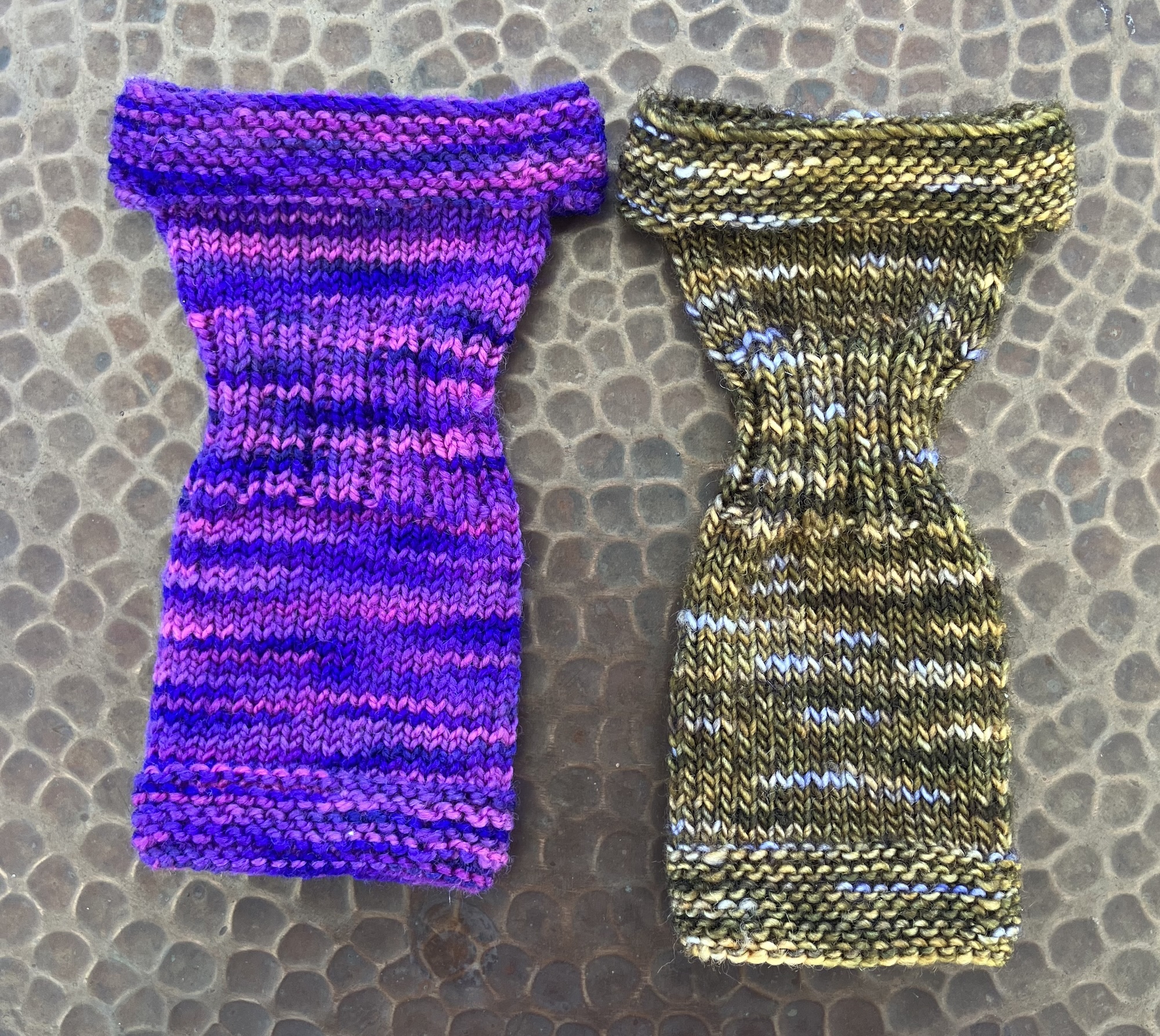
I tried the dress on my skinnier girl and it was too big, especially in the shoulders. I could have diminished the stitch counts again, but remembered the differing results I had with different yarns when knitting sweaters for the girls. Mad Tosh Merino Light is still a fingering yarn, but it’s much thinner than Koigu KPPPM – Koigu KPPPM has 160m per 50g, or 320 m per 100g, while MadTosh Merino Light has 384 m in 100g. It’s thinner.

I followed the same instructions and used the same needles, and look at the size difference:

two dresses knit for Barbie by Deborah Cooke, one in MadTosh Merino Light and one in Koigu KPPPM

Purple is Koigu KPPPM and the brown is MadTosh Merino Light. I may have added a row or two more to the length, but it’s amazing how much skinnier the second dress is. (It also took 10g of yarn.)

And here’s the brown dress on a MTM Barbie with the regular body sculpt:

A dress knitted for Barbie in MadTosh Merino Light by Deborah Cooke

She’s the 2025 Barbie Basics #2, and yes, her hair does have a bit of a violet cast to it. Here she is for sale at the big river. (Interesting that it notes this product is often returned. All of the boxes on my 2025 Barbie Basics dolls were damaged. The dolls were fine, but for those who keep their dolls boxed, that would be an unacceptable situation.)

Changes Out There

This week sees some more changes in the world of makers like me. I’m not in the States but was saddened to see Joann’s Fabric stores closing there recently. There’s nothing like a local store to finger fabrics, and pick up notions.

This week, there are two more changes. One is more local to me. The Spinrite factory in Listowel Ontario is closing down. It’s been there over seventy years and the retail store is a great place for mill ends and sales. They haven’t been spinning yarn there for a while, but they ball-and-band yarns for Patons, Bernat, Red Heart and various store brands (like Michaels). Their annual tent sale is a huge summer event. I like to drive up there (or have the mister drive me) when I’m thinking. It’s a lovely drive through farmland with yarn at the end. I will miss it.

Here’s an article in the Kitchener paper about the closure.

The second big change was announced yesterday – the parent company of the big four pattern brands (Simplicity, Butterick, Vogue and McCalls) was sold to a liquidator. It’s the same company that liquidated Joann’s. Curiously, it seems that the impact of tariffs on sewing product brands owned by the parent (Wrights trims and Boye needles, for example) was a driving factor in the decision, as well as the loss of distribution with the closure of Joann’s in the US. It seemed that they were struggling with the shift to digital in recent years, but it’s sad to see them go.

Here’s the article.

What happens from here? Are we shifting to smaller companies and boutique suppliers, or are we becoming a society of people who don’t make things themselves? I know which option I prefer. I’m not sure who I’d be if I wasn’t always making something.

I also feel vindicated for having my various stashes. If this is the apocalypse for makers, I’m all stocked up.

Another Quintessential Cardigan

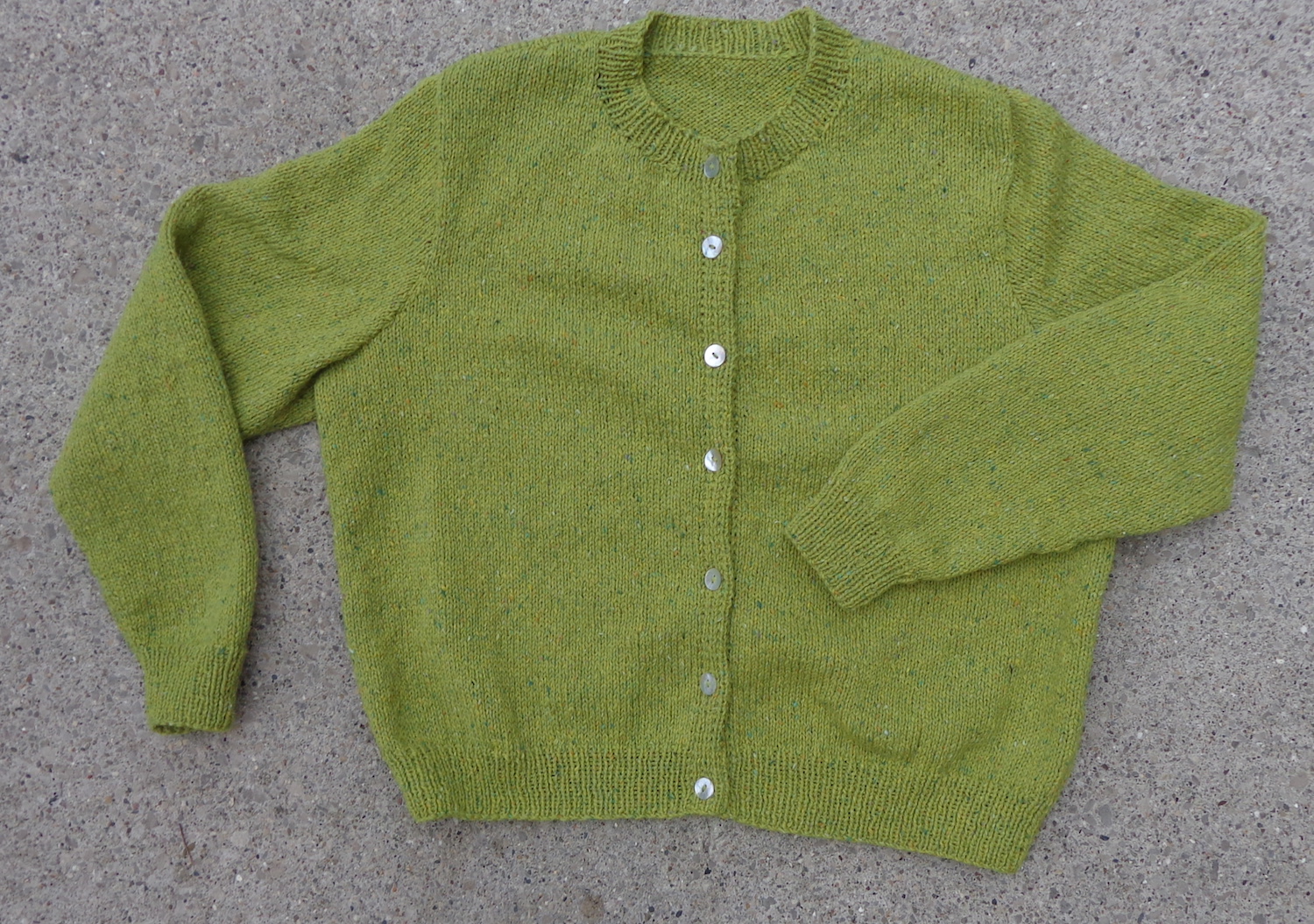
The Quintessential Cardigan is a jewel-necked long-sleeved cardigan that is just a wardrobe staple. I bought it as a kit in two colourways, green and purple, with a tweedy yarn. Here’s the green one, which I finished almost a year ago:

Quintessential Cardigan knit by Deborah Cooke in Jody Long Alba

And here’s the post about it.

I cast on the purple after finishing the Which Way Shawl. This time, I decided to knit the button bands in moss stitch instead of ribbing. I’ll also add a few more stitches to the cuffs to make the wrist a little wider. The sleeves on the green one fit, but I often push up my sleeves and that’s a big snug with wrists like this. I like how the tweed is knitting up.

Quintessential cardigan cast on by Deborah Cooke in Jody Long Alba colourway Kilt

This style of cardigan is one I wear a lot, so I also got out two others of a similar shape to compare the fit. On the left is one of my Hebrides cardigans, knit in Rowan Kidsilk Haze. This is my favourite cardigan – light, warm, pretty and a perfect fit. The hems and button bands are in moss stitch on this one. On the right is my Lunenberg cardigan, knit in Koigu KPPPM. This one is a little wide in the shoulders and the sleeves are a bit long, but that’s okay since I push them up. I also wear this one a lot. The hems and button bands are in garter stitch on this one.

Hebrides by Lisa Richardson knit in Rowan Kidsilk Haze Stripe by Deborah Cooke
Lunenberg Cardigan by Andrea Hungerford knit in Koigu KPPPM by Deborah Cooke

Comparing them all, I decided to make the body of the Quintessential cardigan slimmer as well as longer, turning it to more of box shape. I did lengthen the pattern last time by 2″ but still had yarn leftover, so it can be even longer than that (esp if it’s narrower). The moss stitch hems will help with that change of shape, too.

Onward with a thousand miles of stockinette!

Which Way Shawl Completed!

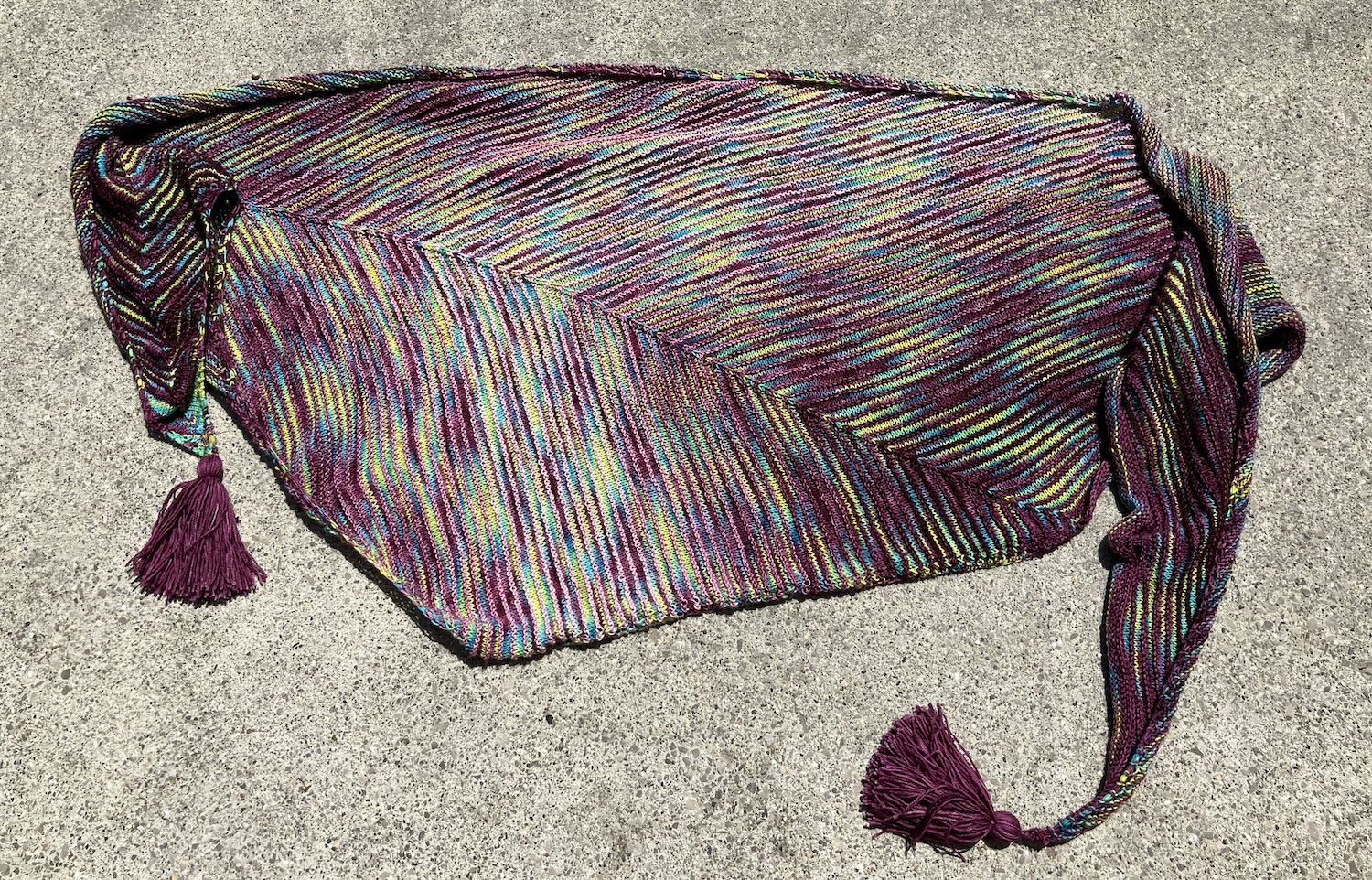
Another project off the needles. The Which Way Shawl is done and here it is:

Which Way shawl knit by Deborah Cooke

Here’s the pattern on Ravelry again.

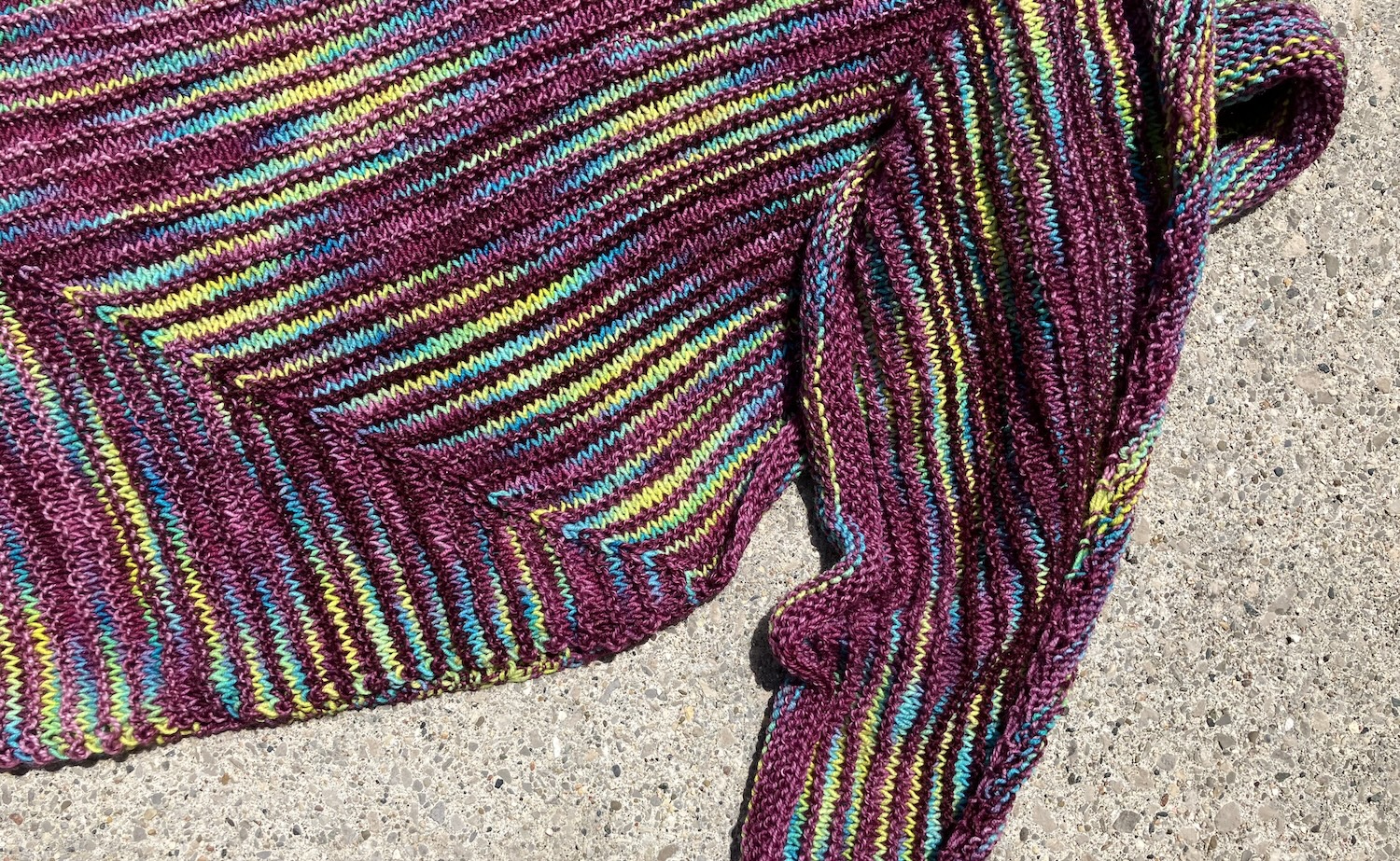
Do I love this shawl? Mmmmm, I dunno. The design is interesting – I’d probably go down a needle size if I ever made it again, though it is nice and squishy. That contrast colour is a different choice for me – while it’s a good idea to try new things, I think I would have loved the result more if I’d gone with my original impulse of using a navy or black for the main colour. Maybe it will be just the right bright thing on a winter’s day. I do like the colours better at the ends than in the middle.

Which Way shawl knit by Deborah Cooke

The shape of the shawl is unusual, but it makes a manageable cowl when wrapped around the neck. I expect I’ll wear it that way when I do wear it. I added tassels to the points that I’ll probably tie together.

Now to choose another project. It would be best to finish up something already started. There’s a little summer cardigan that would be a good choice to finish right now, and I love the colour of it. It’s a Martin Storey pattern called Peridot, which I’ve been knitting in Patons Silk Bamboo for half of forever. (Lots and lots of stockinette stitch.) That’s a Ravelry link, btw. Also my chunky No. 9 pullover in Blackstone Tweed still needs sleeves – funny that it’s almost the same shade of blue as the little cardigan. More blue on the needles with my Water shawl that needs finishing. That’s a blog post link. And of course, there’s my Wild Grass pullover which is at the point of needing acres of stockinette knit.

While considering all of these options, I cast on the purple version of the Quintessential cardigan. I’d bought two kits, one in green and one in purple, so will knit the second one with a few changes. It also requires miles of stockinette, but it’s purple and I need a purple cardigan. 🙂

Pretty Socks

Knitted Socks from Finland

My friend sent me this book at Christmas, full of pretty sock patterns. I don’t usually make pretty socks – I stick to my tried and true, usually in a self-striping yarn – but the socks on the cover are so pretty (and knee socks!) that I had to cast on a pair. I was due for a little fair isle project.

It’s curious that I find knee socks so irresistible – I never wear the ones I’ve knitted, but I do love them.

The book is called Knitted Socks from Finland, and it’s by Niina Laitinen. (The title and image are both linked to the book’s page on the publisher website, which displays buy links too. A lot of smaller stores appear to have the book in stock, so there are plenty of places to buy a copy other than the big river.) The pattern for the socks on the cover is called Dear Sister, and the book includes complete charts. I had a peek on Ravelry before casting on, and could only find the book in the original Finnish: the pattern is called Siskoni Mun. (Those are both Ravelry links.)

It’s always fun to scroll through the completed projects there and look at yarn choices – some Ravellers had knitted the socks in Knit Picks Chroma Fingering, a single ply fingering weight that is available in both solid colours and gradients. (That link will take you to KP’s product page.) I have some Chroma in my stash, but wouldn’t have thought of using it for socks – it’s very soft, partly because of the loose way it’s spun, and even though it has 30% nylon, I wouldn’t expect it to be tough enough for socks. But, I love the gradient look and I had the yarn, so I cast on. I used my trusty pair of short circular needles in 2.5mm, which usually have a sock on them.

I also loved the projects that had used a different background colour than the off-white shown in the pattern picture – why not have dramatic socks? I’m using the solid black for the background and a gradient – the colourway is Lupin – as the contrast. Making a change like this always bends my brain a bit when it comes to the charts. I’m knitting the white squares in black so have to think about that for a minute each time I pick up the project again. I have used some patterns (mittens, mostly) that offered the charts both ways around, which was just great. They were digital downloads, though. In a printed book, that would take up too many pages.

Here’s my progress on the first one. I didn’t do a twisted rib because I’m not a fan – my socks have just plain ribbing at the top.

Dear Sister socks in progress, knit in Knitpicks Chroma Fingering by Deborah Cooke

This is the first chart completed, about a dozen rows of ribbing and fifty-some of pattern. There’s another chart of another 40 rows or so before the beginning of the heel. I’m not sure they will actually be knee socks. They might be mid-calf socks, which is fine, too. We’ll see. Part of that will be due to the yarn substitution, but another variable is legs. 🙂 You can see the model has slender calves. My hiking/biking calves are not that slim, so the sock will be stretched wider rather than taller.

It’s not a difficult knit, but not a TV knit either. Each row is different and there are deceases down the center back of the sock. I have to pay attention a bit. Although I always worry that stranded knitting in socks will get too tight, I think my tension is in a good place on this project. I’m not one of those fast fair isle knitters with one colour in each hand. I put down each yarn and pick up the next one, which does give me a chance to check my tension. It means for slow progress, but it’s meditative. Watching the butterflies form and the colour change keeps me knitting just one more row.

This project also had me reaching into my knitting library for a book filled with wonderful fair isle sweaters – The Tudor Roses by Alice Starmore. I have the hardcover edition from Calla Editions and it’s such a lovely book. I’m tempted to order up the yarn and cast on the Mary Tudor cardigan (that’s a Ravelry link) but need to finish up some other projects first. I have two fair isle cardigans already on the needles, waiting on me. (There were changes to the sweaters between editions. In the first edition, the Mary Tudor sweater was a pullover. That’s a Rav link again.)

The Chroma yarn is very soft (and a bit splitty, as loosely spun single ply yarns tend to be.) These will be lounging socks, not hiking socks. And yes, I’m hoping to make them match because that’s just how I roll. It looks as if there are two repeats of the colour gradation in the ball, so fingers crossed.

Onward. They are a bit addictive once you find a bright spot to work…

More on the Which Way Shawl

I have been making progress on the Which Way shawl. I first told you about it in this post than updated you in this post. This is a whole lot of knitting.

Today’s milestone is that I’ve run out of yarn. :-/ Both bundles of gradient-dyed yarn are used up and the shawl isn’t done. This is likely because I’ve somehow mucked up the decreases. I want the lower edge to be decreased to nothing before binding off, as I think it might look odd otherwise. This requires a lot more repeats than specified in the pattern.

I have a persistent feeling that I’ve made a mistake, so took the shawl off the needles to have a look.

Here we are. It’s a dingy day and raining too hard to take the shawl outside for a pic. Also, it’s huge, and I couldn’t get it all in the shot.

Which Way shawl knit by Deborah Cooke

It’s that bottom wedge that I’m diminishing until it vanishes. At this point, there are 18 stitches there so I’ll need another 9 contrast stripes to finish that out. The pooling is from the main colour, which is hand-dyed, but it seems to have worked out pretty evenly. I don’t mind it. And I don’t mind the size of the shawl. I’m just wondering where I went wrong…

You can just barely see the orange marker in the middle when the decreases were started. The shawl from this point should (I think) be rectangular, and it looks like it will block out that way. I pulled that right tip out longer when I was laying out the shawl.

The pattern specifies 22 contrast stripe repeats after the decreases begin (where the orange marker is). I’m currently at 43. Following the directions, the decreases would have stopped around the point that the contrast yarn (the gradient) started to get darker. (Eyeball a halfway point between the orange marker and the live stitches at the right.) I think the shawl would have been too small then, and an odd shape. There are some finished project pictures on Ravelry that are shaped the way my shawl is now, which does nothing to explain the 21 contrast stripe difference.

Here’s the pattern on Ravelry again. It calls for 4 oz of the main colour, a sport weight yarn, (that’s 113g) and 5 oz of the gradient skeins (let’s call it 150g), knit on US 6 needles (4.0mm). My yarn is fingering weight so I used 3.75mm needles. (I could actually have gone down another size as it’s a loose garter stitch, but it is nice and drapey this way.) I had 144g of the gradients, and 2 skeins of the main colour for 220g total (732m). I’m into the second skein of the main colour and I guess it was predictable that I’d run out of the contrast.

Fortunately, I have another skein of sock yarn in a mulberry shade that is pretty close to the gradient colourways – probably more like the fifth shade than the sixth (maybe even the fourth. You can see it on the right.) I’ll go with it anyway. The fiber content is the same.

I’ll keep knitting and will show you better pix once it’s completed. I still have no clue what I did wrong, but the end result looks okay, so it will be what it will be.