DIY Barbie Carrying Case

Thanks to Astro-Jen, I’ve rediscovered my Barbie dolls and how much I like crafting for them. I’ve also added a few new dolls to my collection, including the 1993 Reproduction that I’ve been using as a model, and two Silkstone lingerie Barbies. They’re glamorous girls.

The increase in Barbie “stuff” – clothes and dolls – had me looking for better Barbie storage. I really like the Silkstone Signature Carrying Case, but it’s discontinued now and the NIB ones I found on eBay were at least $300US plus shipping to Canada. (Here it is on the Mattel site.) I needed a more economical solution, which meant it was time to get creative.

I had bought two boxes at Michaels to store my girls, but the dolls were just stacked inside. They’re decorative storage boxes made by Ashland and I’m quite sure I bought them when they were BOGO because I have two exactly the same. They have a handle on each side, a clasp on the lid and are really pretty. They’re the larger ones, roughly 11 by 14 inches and 6 inches deep. I turned one on its side and Eureka! It’s a carrying case!

materials for DIY Barbie wardrobe by Deborah Cooke

First, I removed the handle from the left side, which made the other one a carrying handle and gave the box a vertical instead of horizontal orientation. I then cut the existing ribbon that kept the box from opening more than 90 degrees and began to build interior partitions. There’s room for 3 dolls on the inside of the lid, and I borrowed the idea from that Mattel case of having ribbons to hold them in place. That meant I needed a liner.

Several years ago, I took a bookmaking course, which was fascinating, and I still have some of the supplies. I used the Binder’s Board for this project. This is really really thick acid-free cardboard. I bought a package like this at Curry’s back in the day. It’s been waiting for this project, evidently. I cut one piece to the width of the lid interior and a little more than the height of the dolls (12″) with a flap the depth of the lid. I scored that line and folded it, then cut two squares to go above the “shelf” and hold it in place. Then I cut three pairs of slits (2 cm apart) for the ribbons.

lid liner for DIY Barbie wardrobe made by Deborah Cooke
DIY Wardrobe for Barbie made by Deborah Cooke

This shelf ultimately was a fail, because it was too deep. I hadn’t accommodated the thickness of everything together and ended up cutting it out, which made a mess of my panel. I also didn’t realize at the time that Silkstone Barbie was 1 cm taller, so the ribbon was too low for her. (That’s why she looks a bit drunk.) The ribbons could have been a bit longer, too.

DIY Wardrobe for Barbie made by Deborah Cooke

I took it apart and redid the back panel to fit the entire back, and just hold the three dolls. I ran out of the paper, so used a different one instead. You can see the finished liner on the right. (She still looks a bit drunk, but has no excuse in terms of the ribbon.)

The ribbons were pushed through the slits before I glued that backing in place – I was going to knot them but it was a snug fit. I put a dab of extra glue on them in the back just to make sure they didn’t move.

For the other side of the wardrobe, I created a box the width of the box interior. Again, I scored and folded it – I needed the sides to install the clothing rod. The clothing rods are bamboo skewers, coloured black with a Sharpie marker, and fed through bamboo beads that act as escutcheons. The side panel is notched out, then another side panel sandwiches the end of the rod on each side. I positioned the “closet” so that there was just over 2″ at the bottom and – like the other side, created braces for the shelf at the top. After taking the “before” picture, I decided to split the closet to make it more stable, and add a second clothing rod on the right side.

Here it is wallpapered and with drawers:

closet side of DIY wardrobe for Barbie made by Deborah Cooke
DIY Wardrobe for Barbie made by Deborah Cooke

In the left image, you can see one of the challenges of using these paper boxes – this one isn’t square. (Paper isn’t the most dimensionally-stable material.) It’s narrower at the back of the closet than closer to the opening. So, fitting the board for the back of the closet to the box meant that the shelves bent outward. In the end, I taped it square before covering it, and lived with the small gap that developed around the perimeter. The pattern on the paper disguises a lot! I also didn’t need braces at the top to keep the shelf in place – it was very snugly tucked in there.

I made my first drawer out of the kind of cardboard that is on the back of writing pads, folding it as shown below. Because I decided to use brads for the knobs, I cut an additional panel for the back of each drawer front so the ends of the brads wouldn’t snag anything. Here’s my first attempt at a drawer and the component materials. (That’s the drawer at the top right.)

First attempt at drawers for DIY Barbie wardrobe made by Deborah Cooke

I thought this drawer was too flimsy, so I made two new ones out of the Binder’s Board. I couldn’t fold those, because of the width of the material, so I cut the six sides and taped it all together, then covered each drawer with decorative paper. They’re lined, too.

The blue floral print is decorative paper from the Rifle Paper Company, which I bought online at The Paper Place. (Because of the postage cost, this is my big expenditure on this project. All the other supplies came out of my stash.) For surfaces that I expected to see a lot of wear, I covered the paper with clear Contact vinyl with a matte finish – it’s pretty much invisible but will make the surface more durable. I used it behind the dolls and on the drawers. I used a bookbinder’s glue because I had it – it’s acid-free – but white glue would work, too. If I hadn’t messed up one drawer and the back panel on the front, I would have had enough paper to do it all the same. As it was, I chose to add a second print from my bookmaking stash rather than order more paper.

The finished inside looks like this:
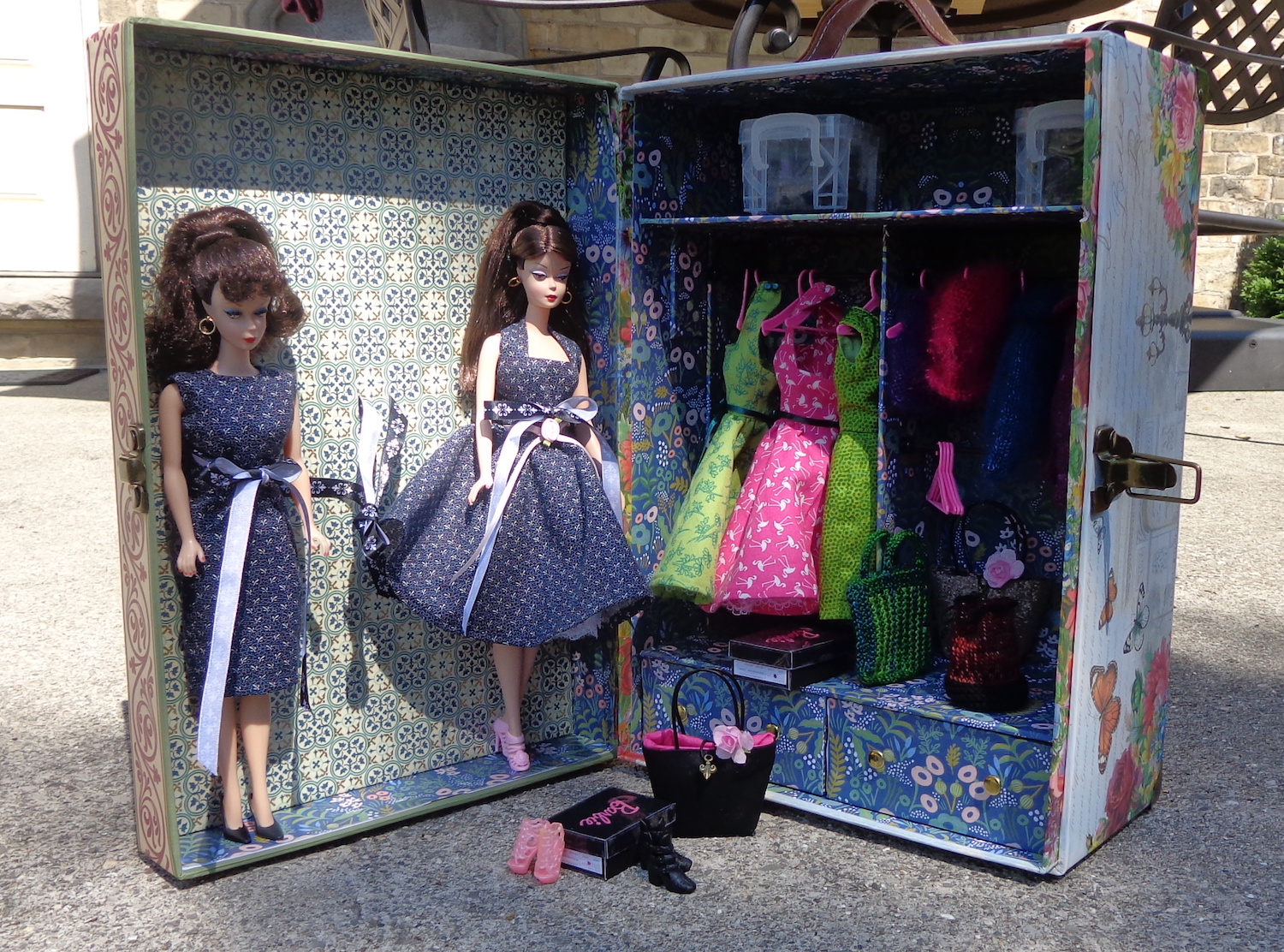
DIY Wardrobe for Barbie made by Deborah Cooke

The shoe boxes are from a PDF download that I bought on Etsy – you print them out on card stock, then fold them and glue the flaps. I applied a clear gloss Avery label on the lids of the black ones, too. This is the PDF I bought.

I put felt pads on the bottom of the box for feet, as well. In this shot, you can see the two metal rivets from the second handle. I couldn’t get them out, but they’re shorter than the felt pads so all is good. I put felt pads on the lid, too, so the wardrobe isn’t tippity when it’s open.

DIY Wardrobe for Barbie made by Deborah Cooke

The front of the box had an Eiffel Tower which ends up sideways with this orientation, so I covered it over with decorative paper, also covered with Contact vinyl with a matte finish. I added some gold tape on the edges all around. I made a label on Canva, a free online graphics utility, printed it out on parchment paper and edged it in gold, too. The sides of the box still have sideways images, but I can’t repaper them without removing the corners and clasp, which I don’t want to do. I’m going to live with that.

Here’s the front, with my label – and some teeny tiny stickers from the dollar store that look like rivets. (Ha.)
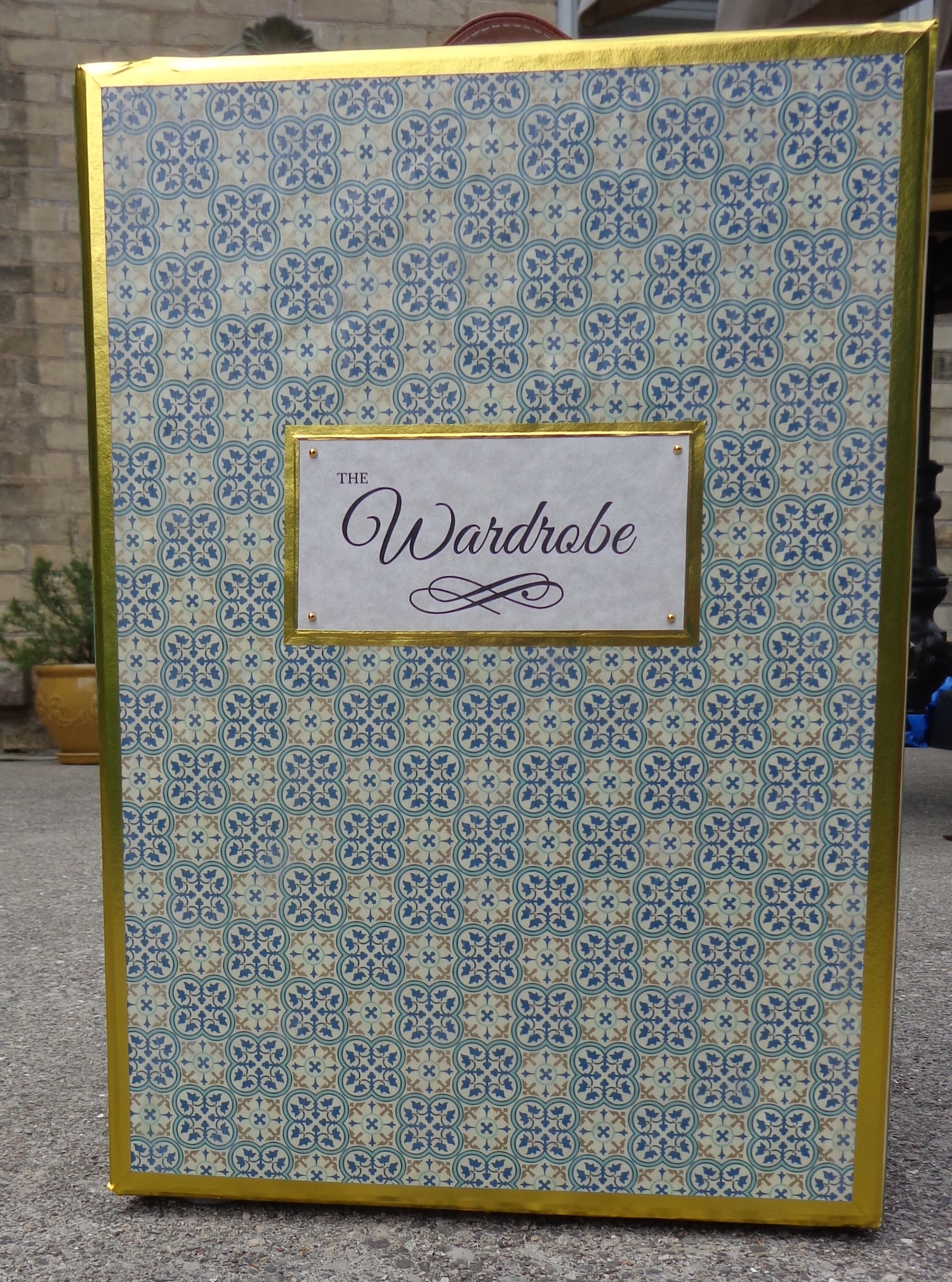
DIY Wardrobe for Barbie made by Deborah Cooke

This wasn’t a very expensive project, but it did take some time. You could, of course, make one for a doll of different size, changing your choice of box and the size of the inserts, and design a different interior to accommodate your collection. If I did another one, I’d look for a patterned Contact vinyl and save the step of putting the film on the paper. I’m thinking of making one for my EverAfter doll out of a decorative box that looks like a book. Since it has a flat lid, I’d make a section for the doll then a wardrobe beside her.

What do you think?

Barbie Measurements Over Time

Last time, we started to talk about Barbie’s evolving dimensions. If you’re going to sew for Barbie, and you’re going to make something fitted, you need to know which Barbie will be wearing the finished garment.

Barbie body styles, photographed by Deborah Cooke

Fortunately for we Barbie dressmakers, each doll has the date of her body mold stamped on her bum. It’s interesting that this can get so mixy-mixy with face sculpts – the middle doll, for example, is a thrift store find who has a Bob Mackie face sculpt. (I’ve yet to fix her hair.) Mattel started making the Bob Mackie faces in the 1990s but she has a 1966 TNT body, by the date on her bum. The Black Label Basic Barbie from 2009 on the far right has a 2003 Model Muse body. The one in between has a 1999 Bellybutton body, but is a much later doll. (Notice also how the hand poses and sculpts change over time. There are lots of variations in this.)

Like good dressmakers everywhere, I got out my measuring tape and made a chart. I don’t have all the dolls to measure, but here are the five above. The measurements are in centimeters:

MeasurementVintageSilkstoneTNTBellybuttonModel Muse
Intro Date19582000196619992003
Bust14131412.512
Waist87897.5
Hip12121213.511
Back Waist66666
Inseam13141313.513.5
Height29.530.529.53030

It’s easy to see why a dress or suit drafted for Bellybutton wouldn’t fit vintage, especially in the bust.

The other thing that changes over time is Barbie’s foot size. I’ve bought mixed bundles of new shoes on eBay and there are always some in the package that don’t fit vintage Barbie. There are fairy boots in the mix, for example, with teeny tiny feet. There are also styles that look like they should fit but don’t, like this one:

Barbie Shoes comparison

I’ve left this image big so you can see. The turquoise shoe on the left is from one of those packages of mixed shoes. The one on the right is a Silkstone Barbie shoe. Not only is the quality of the casting and finishing better, but the dimensions are different: the turquoise one is narrower at the ankle. Vintage, Silkstone, TNT, Bellybutton and Model Muse can wear the shoe on the right. Of the five, only Bellybutton can wear the one on the left. She doesn’t have as high of an arch so her foot is narrower below the ankle.

Here’s another Silkstone shoe compared with a budget version:

Barbie Shoes comparison slingback

The black shoe on the right is a Silkstone shoe. The pink one on the left is from a pack of mixed shoes. Again, you can see that the quality of the mold and finishing is better on the black shoe, but also the heel is higher. For Silkstone, these shoes have left and right as well, with a buckle molded into the slingback strap – you can see it on the back side – while the budget version doesn’t have that detail. These shoes both fit all five dolls, but I always think they look like the toes are too long. Of course, I’ve had shoes with elongated toes like that myself, so it’s a style thing.

So, what’s a dressmaker to do? My first plan is to buy only patterns that are modelled on the kind of doll who will wear the finished garment. More about some of those patterns for vintage Barbie next time.

A Question of Fit

I often have fitting adventures when I sew for myself, but I never expected to have so many fitting challenges for Barbie. Among my recent fails has been this top for Barbie. It’s a cute pattern and very cleverly designed, but it was my first big lesson about fit for my 1/6 scale friend.

This is another free pattern from the Sticka til Barbie website: a sleeveless top with some great bias shaping detail. It’s pattern 174 (that’s a Ravelry link) which also includes a trumpet skirt.

Knit Top 174 from Sticka til Barbie website, knit by Deborah Cooke

This little top is knit flat and seamed up the centre back. I knit the first one (reddish) in MadTosh Merino Light and it was very snug on my vintage Barbie. VERY snug. It was tough to get on her at all. Hmm. What was wrong? I used up one stitch for the seam, but that didn’t seem excessive.

My friend Terri is a tailor and we talk about fit a lot. One of the things she considers when fitting women is shape, and the location of curves. She talks about drawing an imaginary line down center front and another down center back, then one down each side seam. This divides the bodice into four quadrants—but they probably aren’t the same size. One woman with a 40″ bust could be buxom with a narrow back, so maybe each front “quadrant” is 13″ wide and each back one is only 7″ wide. Another could have a broad back while yet another could be asymmetical. Knowing where your curves are means that you can adapt the pattern to fit. So, this little top isn’t taking that into account at all. Vintage Barbie is very buxom, yet this top divides into four equal quarters. It has no back or front. Of course, it will be snug for Barbie.

With this in mind, I knit a second (green) top in Malabrigo Sock, joining it to knit in the round – which gave me one more stitch because there wasn’t a seam – and added two stitches to the front, one on each side. This one is still snug – in fact, it’s not a lot bigger than the first one because the Malabrigo Sock is a thinner yarn. Hmm.

I switched to larger needles for the next one and a thicker sock yarn. This is the bright red one. I also added one repeat to the length. It came out bigger, longer and thicker. It’s a better fit for vintage Barbie. I’m not so fond of how thick it is, though.

The curious thing is that in the pattern picture, the top looks loose in the bust. What’s different? The doll modelling the top is not a vintage Barbie.

McCalls 7550

Similarly, I had issues with the sundress from McCalls 7550 being too snug in the bust for my vintage Barbie. After writing that blog post, I made the suit (shown in shades of taupe on the pattern envelope) in some scraps of silk dupioni. The jacket was snug but fit all right as long as she had nothing underneath. (Not perhaps the best look for semi-formal wear.) The dress was so tight that it was ridiculous, and the jacket wouldn’t go over it at all. That one went into the trash.

Once again, the doll modelling the clothes is not a vintage Barbie and that’s the key.

There is a difference in measurements between vintage Barbie and newer Barbie, as shown on this free download of slopers for Barbie. (This blog post includes instructions on drafting patterns from the sloper. Look in the sidebar of the website for Downloads, then you want BarbieBasicPatternSet.pdf) There are two styles accommodated here: vintage Barbie and what she refers to as the newer Barbie body style from the early 2000’s.

There are, though, a lot more variations than that. I have a number of Barbies, some having been my dolls and some from the thrift store, and when I line five of them up, it’s easy to see the changes in body style and dimensions. Have a look at them naked:

Barbie body styles, photographed by Deborah Cooke

From the left – vintage repro Barbie, Silkstone Barbie, Twist-and-Turn Barbie, Bellybutton Barbie and Model Muse Barbie. The bust size changes between these three body types, as does the height – and the dimensions of the foot. It looks like the curves of the original Barbie were made less dramatic, beginning with the Bellybutton Barbie – vintage and TNT are very similar in shape, but Bellybutton has a smaller and higher bust as well as a thicker waist. Then the vintage shape made a comeback with Silkstone and other collectibles, with some changes. Silkstone is slimmer and taller than vintage, for example, with a higher bust. Model Muse is another thing altogether, the slimmest of all of these and also taller than vintage, TNT and Bellybutton. This doesn’t consider other 11.5″ dolls from other manufacturers and their dimensions or the current body styles. Given the scale, it’s pretty easy to see that something that fits one of these dolls might not fit the others. Model Muse can wear the two tops at the top of this post – in fact, they’re a bit baggy on her.

Of the slopers posted in the link above, “old style” will fit vintage and TNT. “New Style” will fit Bellybutton. That body type was used on a lot of dolls, including My Scene dolls (which have bigger heads), and can be easily identified by the cross-hatch “panties” – and the bellybutton, of course. Silkstone can wear “old style” but it will be loose around the middle. I haven’t figured out Model Muse with her tilty hips.

This means that Barbie is that most annoying of dressmaking clients—the woman whose measurements change over time. (Even her height and shoe size changes.) Just as with any other dressmaking, I need to know my client’s measurements to get the best fit.

We’ll talk more about that next time.

1/6 Scale Market Bags

After trying the purses for Barbie from that McCalls pattern, I was inspired to try some market bags. I watched a couple of YouTube videos which were for 1/12 scale minis then fiddled around on my own. Here are the first results:

1?6 scale market bags designed and created by Deborah Cooke

These bags are about 2″ high, 3.5″ with the handles. They’re lined and the handles are leather cording. They have little charm fleur-de-lis clasps and elastic loops to keep them closed as well as beads for feet. The one at the far left has a jewelry charm for a clasp instead. The one on the far right was the first one, and it’s a bit narrower than it should be. I widened my template for the others.

The brown fabric is a silk linen blend suiting that I bought in Paris in the 1980’s. I made myself a suit from it – long gone! – and these are remnants. The black fabric is quilting cotton. The bags are lined with French shirting fabric (that bit of red stripe), Liberty Tana Lawn (the other two brown bags) or silk/cotton voile. The roses on the bags are paper roses (are you singing along with Marie Osmond?) and the bouquet is a cluster of ribbon roses that I wrapped in tissue, like they just came from the florist.

The box is a desk organizer from the dollar store with a nicer paper glued in for backing. It’s 6 x 9″ and is the foundation of a display case for the store diorama that I’m creating for Barbie and her friends. Yup, another rabbit hole has opened wide…

McCalls 7550

McCalls 7550

McCalls 7550 is a mini-wardrobe of vintage styles for 11.5″ fashion dolls like Barbie. It’s a current pattern, and I’ve linked it to the Simply Delightful website for Vogue, Butterick and McCalls patterns. You can buy it in hard copy or as a digital download, either there or from a local fabric store. I have a hard copy.

I liked the vintage look of these garments for Barbie and made the sundress shown in blue and white on the pattern envelope. It’s a halter back dress with a full circle skirt and is Dress E.

Here are the pattern line drawings:

McCalls 7550

I made this first in a green quilting cotton but wasn’t as happy with the result as would have been ideal. Piecing that bodice is fiddly and it’s a challenge to get those seams to lie flat on the front. My corners didn’t turn as nice crisp points even though I trimmed the seam allowances. And the bodice is tight on my vintage Barbie. I think there are three reasons for this: first, the doll photographed is a newer and less curvy model; and secondly, the fabric is probably thicker than would be best, and thirdly, I didn’t follow the directions closely for the back.

Here’s Babs showing off that version:

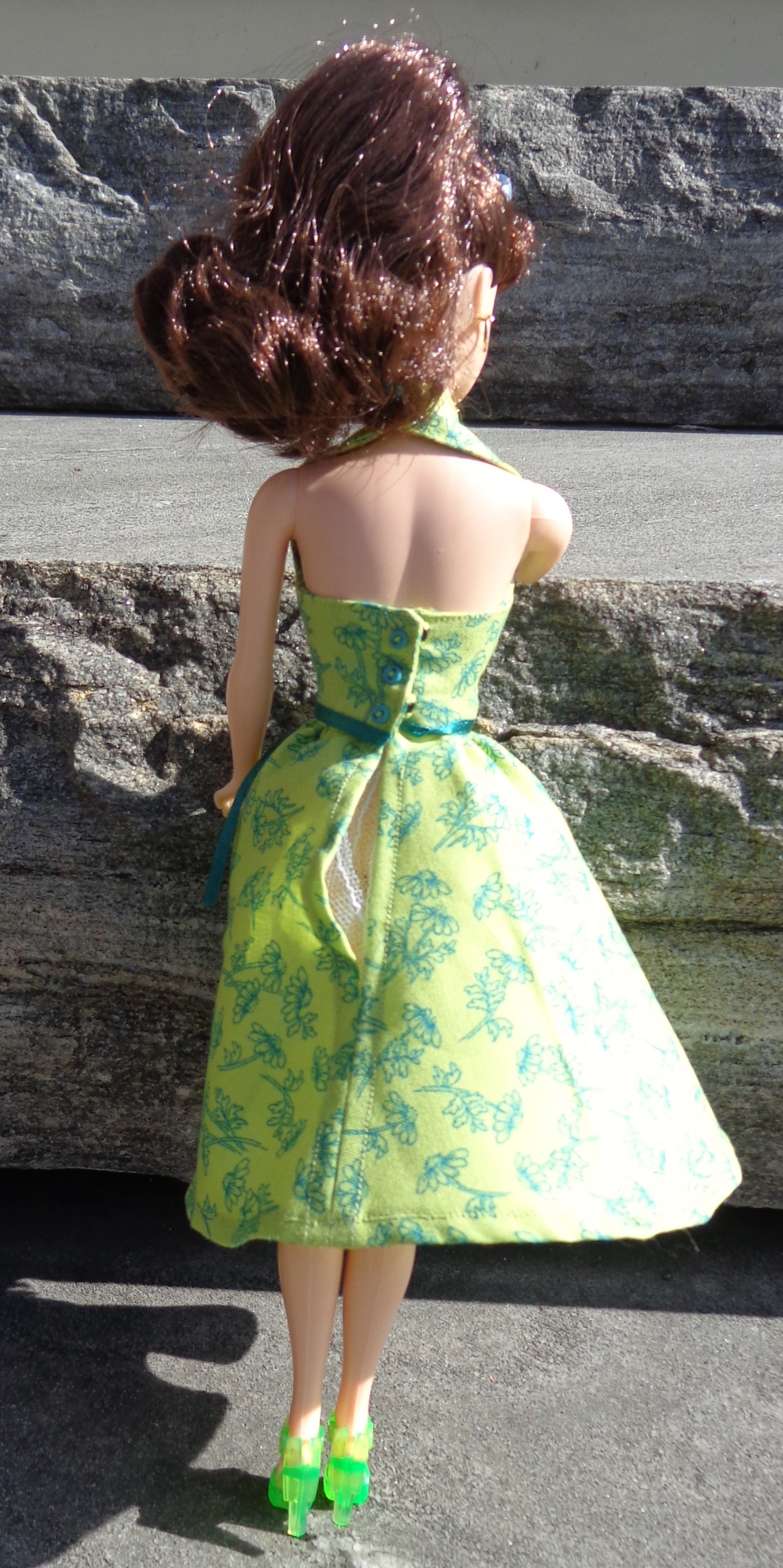
McCalls 7550 view E sewn by Deborah Cooke

The front looks good, but see at right how the back gaps open. (And yes, I sewed on little contrasting buttons.)

McCalls 7550 view E sewn by Deborah Cooke

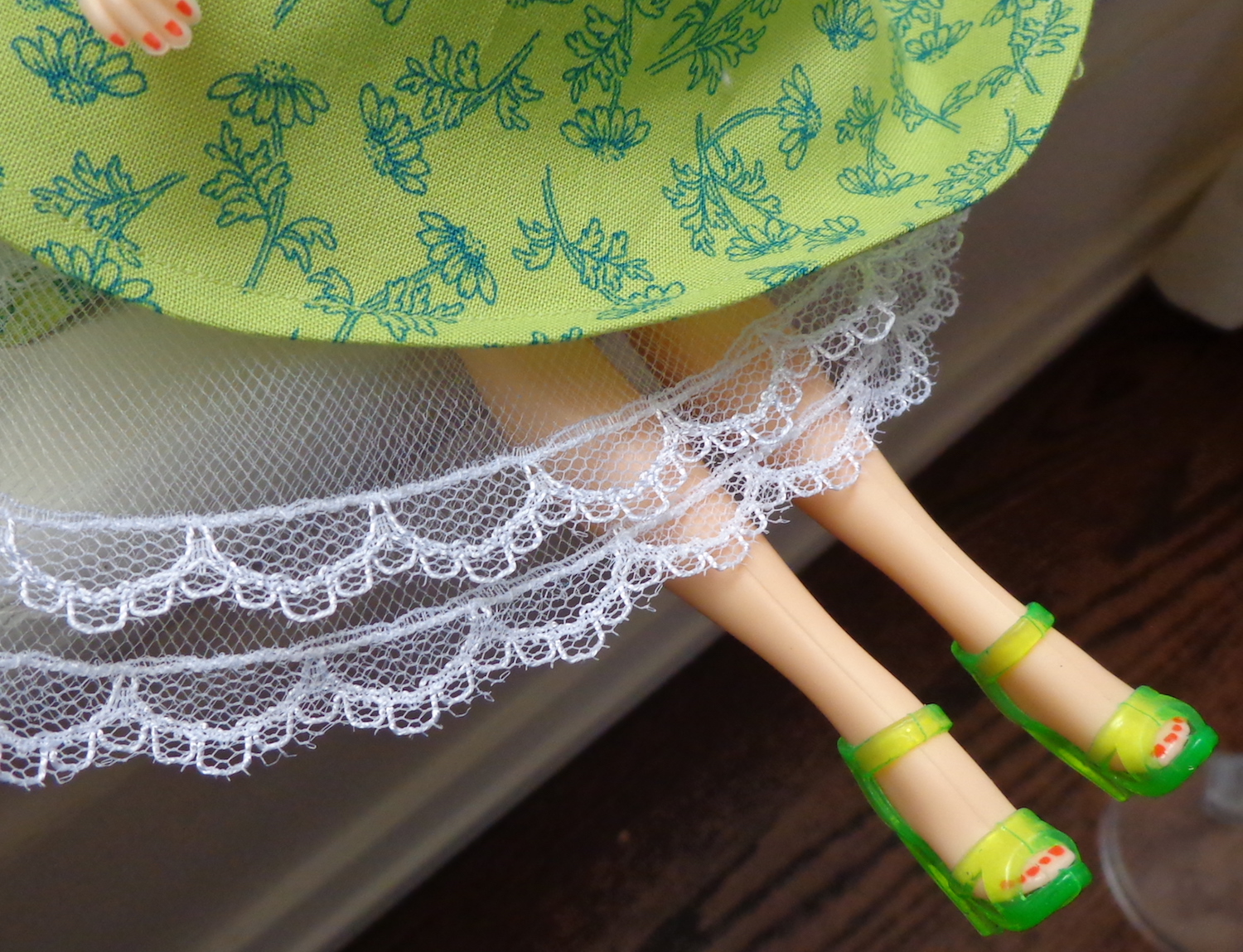
Even on this version, I did make some changes. First, I sewed lace on the hem on the tulle underskirt. Secondly, the bodice is lined, but after piecing it, you’re instructed to sew around the raw edges of the center back and waistline – when you join the skirt, there will be a raw edge inside the garment. I couldn’t see the point of having a lining if that was the case, so I tucked the raw edges in between the bodice and the facing. I had done the same for the center back, but then didn’t have enough fabric for a good overlap for the snaps – that contributed to it being tight. Finally, I added a ribbon around the waist, sewing it into the center back seam on each side, then tying it at the front and tacking it down there so the bow can’t come undone.

I made the dress a second time, and read the directions for the back more closely this time. This version is better. This is another quilting cotton but it’s not as thick as the green print.

McCalls 7550 view E sewn by Deborah Cooke

I forgot to tuck the ribbon ends into the center back seam (duh) so had to sew them by hand. This time, I only used one layer of tulle instead of two, but I put lace on the edge again. This one also got a ribbon rose and (again) contrasting buttons. 🙂 I made the same changes with putting raw edges inside the bodice and facing, but only used a 1/8″ seam allowance at the center back instead of 1/4″. This fit vintage Barbie much better and the opening below lies more smoothly. I think it should be finished more, though, so there’s a version three.

McCalls 7550 purses sewn by Deborah Cooke

I also tried both purses from this pattern in a shiny fake leather. I love the clutch – which is upside down in the picture! – and it was both quick and easy. The other purse is a bit floppy, plus I thought the strap was short and thick. The flap curls on that one, too, so maybe the fake leather needs to be doubled over or interfaced. Maybe the bag needs to be lined. Modifications are required!

For version three of the sundress, I applied fusible knit interfacing to the center back seam allowance for the skirt. This will ensure the edges can’t fray after the garment is done.

And here’s version three with the new purse!

McCalls 7550 view E sewn by Deborah Cooke

My model is a Silkstone Barbie, new to me. She’s Lingerie #2 from 2000 and I bought her NIB on eBay. Her hair needs to be redone since the elastics have disintegrated over time and her lingerie is a bit yellowed. I’ll give it a handwash to see if that will clean it up. I hadn’t seen a Silkstone Barbie before and there are cool things about her – a little more detail in the sculpt and the material makes her heavier. Her knees don’t bend, though.

I was so busy trying to get her to hold her new purse that I didn’t realize she was doing a drunk-lean on the steps.

This quilting cotton is probably the thickest of them all and that made the flamingo dress a bit challenging. I’m tempted to try one in Liberty Tana Lawn just to see how much easier it would be in a thinner cotton, but I need a break from this dress.

Fiddly fiddly sewing for Barbie! I like the challenge, though, and I’ll show you some market bags that I created in 1/6 scale next.

Knit Purses for Barbie

Sometimes you need a quick project and some instant crafty gratification. Here’s a recent favorite of mine – some knitted purses for Barbie.

The patterns are from a website of free knitting patterns for Barbie called Sticka till Barbie. It’s in Sweden and is amazing. (The pictures are teeny, but it’s worth a good look.) There really are more than a thousand patterns for Barbie and about 300 for Bratz dolls—including 8 years of ABBA costumes. (Click ABBA on the menu bar to see, then they’re sorted by year.) There are project pictures on Ravelry and since they’re larger, it’s easier to see details there – here’s the designer page on Ravelry.

purses for Barbie knit by Deborah Cooke

On the right is A-7 – a circular drawstring bag. I knit mine iwith some red MadTosh and black Malabrigo Sock, adding a bit of detail above the colour change. I put a little cardboard square in the bottom. The drawstring is a manufactured cord instead of a knitted one.

On the left is A-5 on the same page – a striped tote bag. This one’s knit sideways – you do the stripes first, join the strip into a ring, then pick up stitches for the handles. Someone on Ravelry suggested a provisional cast-on and 3-needle bind off, which seemed like a good idea to me. I grafted the loop together, though.

These are quick knits and a bit addictive, plus a great way to use up scraps of sock yarn. I know I’ll be knitting more!

If you knit for dolls, this site is a great resource.

Cardigans for Barbie

This project is actually the one I cast on before the shrugs but finished later. Why? Because it’s fiddly.

Knits for Barbie by Nicky Epstein

Here’s the book the last time Jen tempted me to knit for dolls. 🙂 It’s called Knits for Barbie and is by Nicky Epstein. It’s out of print, so that’s a Ravelry link. There are a lot of cute patterns here, and they’re styled nicely for inspiration.

The specified yarns are often tapestry yarns, but many people on Ravelry use sock yarn. What’s distinct about these patterns to me is that they’re made exactly like sweaters for people from traditional patterns. No top-down seamless stuff here. I’ve never been so glad to finish a project as these two sweaters – and the process definitely made me appreciate the seamless shrug pattern I shared with you last week.

Timely Twinset by Nicky Epstein knit in MadTosh Twist Light by Deborah Cooke

But let’s talk about the cardigans. I decided to make the Timely Twin Set, (another Ravelry link there) which is a cardigan and sleeveless shell. For my first attempt, I used some leftover Madeline Tosh Twist Light in Lepidoptra. This is kind of kettle-dyed and so it didn’t make stripes even on a small garment. I knit the back, the two fronts, the two sleeves, sewed it all together, then picked up the button bands on each front, and finally knit the collar. Just like a big sweater, but teeny teeny tiny!

One thing I learned quickly is that no matter how small the stitches, Barbie fingers are smaller. It’s much easier to try these sweaters on Barbie if she has a pair of mittens on. (Barbie “gloves” are actually mittens as the fingers aren’t separated.) If you don’t have any, you could wrap a piece of cloth or the corner of a sandwich bag over her hand to put on the sweater. My vintage doll has a gap between her pinkie and the other fingers, as well as between fingers and thumb, and it was that pinkie that gave the trouble.

This cardigan pattern has no buttonholes, just buttons on the left, so the sweater is always worn open. I used teeny tiny snaps (five of them) and sewed the buttons on the right front instead. These are 3mm clear snaps that I ordered online. They’re very tiny, which I like, but they’re hard to fasten. I wouldn’t recommend them for little fingers. I might (gah) take them off and sew on plain old metal snaps.

Timely Twinset by Nicky Epstein knit in MadTosh Twist Light by Deborah Cooke

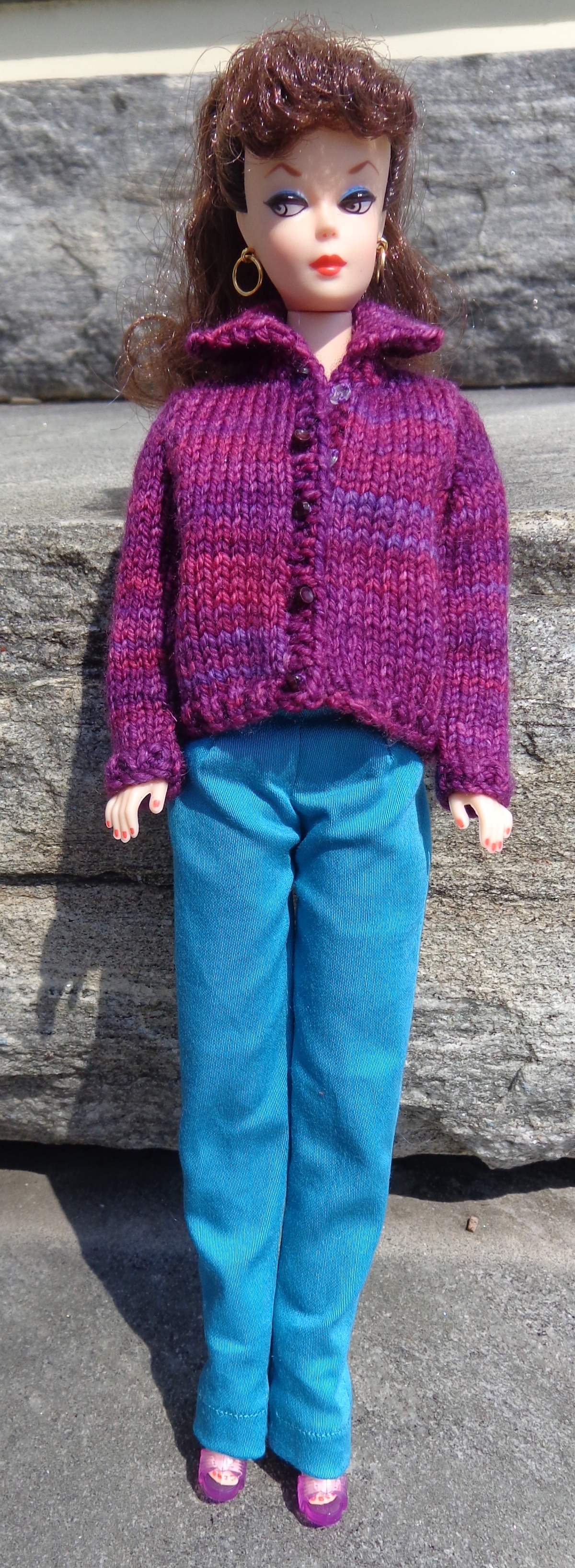
Here’s the finished cardigan from the side:

Barbie is wearing a pair of pants I made for her of cotton twill. They’re a bit too long for her, but we both like the color.

The cardigan is pretty bulky for Barbie – I think it looks better in the pictures than IRL – so I didn’t knit the shell to go with it. Instead, I tried an experiment and knit the cardigan again, this time in Elann Silken Kydd (which is like Rowan Kidsilk Haze).

This time, I eliminated the side seams and knit the body to the underarms, then divided it. I still knit the sleeves separately and did the button bands etc. I did the five snaps and buttons again, and here’s the result:

Timely Twinset by Nicky Epstein knit in Elann Silken Kydd by Deborah Cooke

It’s still pretty fluffy, even though this one came out smaller in the thinner yarn. (Same needles.) It reminds me of a mohair sweater I have myself – it’s exactly the sweater I want when the power goes out, but not so much otherwise. It’s really fluffy and warm, but not flattering at all. It’s knit of that thick mohair that used to be prevalent. I want Barbie to be glamourous not practical!

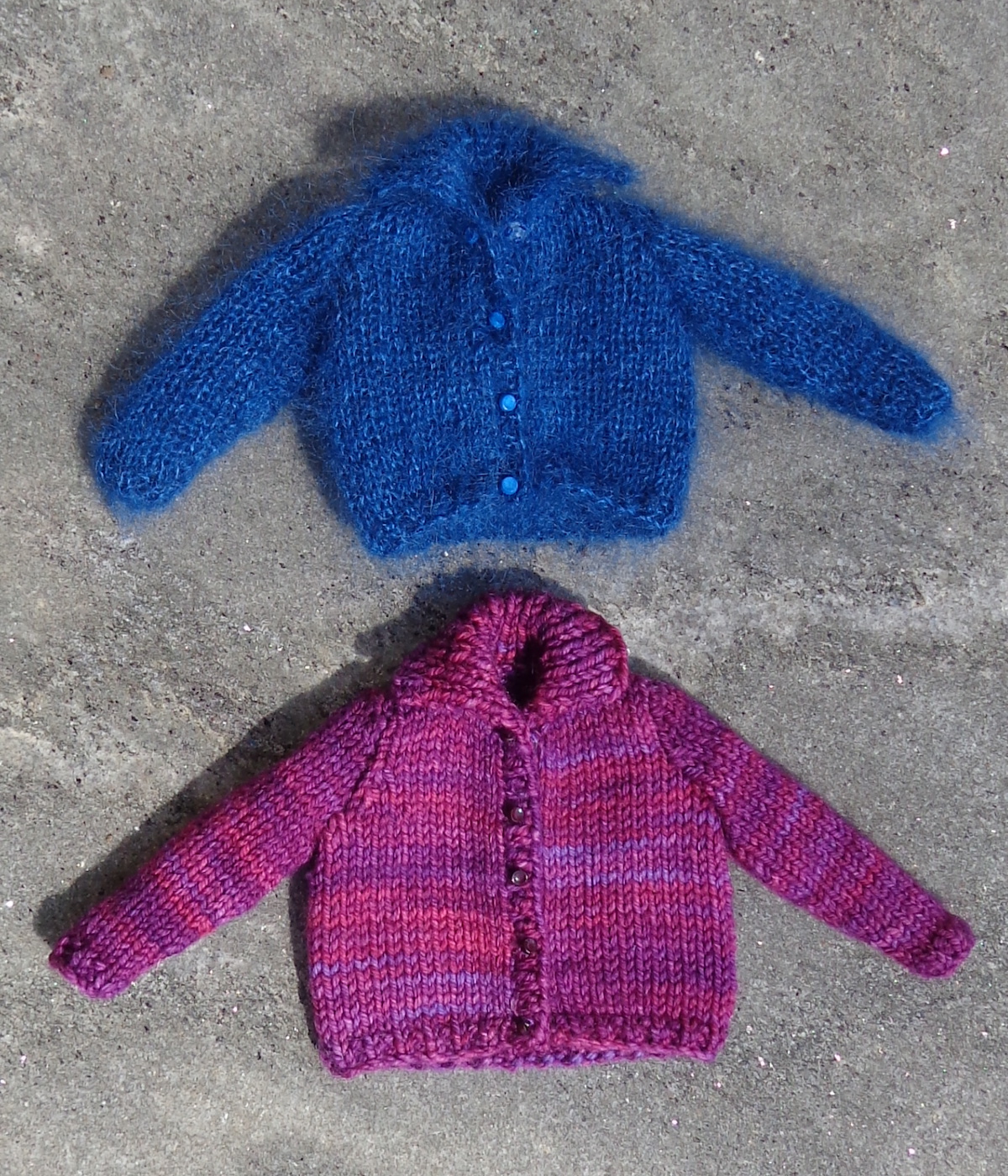
Here are the two sweaters beside each other, so you can see the difference just by changing the yarn:

Timely Twinset by Nicky Epstein knit in MadTosh Twist Light and in Elann Silken Kydd by Deborah Cooke

So, I’ll try a variation, a top-down cardigan with a lot fewer seams. Stay tuned for that!

A Shrug for Barbie

I was tempted into knitting for dolls by my friend, Jen, and this is dangerous territory. It’s really addictive to knit teeny tiny projects – the assumption is that projects will be finishing quickly, but I’m discovering that my need to get it “just right” means these little sweaters take a while. (We’ll talk about sewing for dolls later. I’m further down that rabbit hole.)

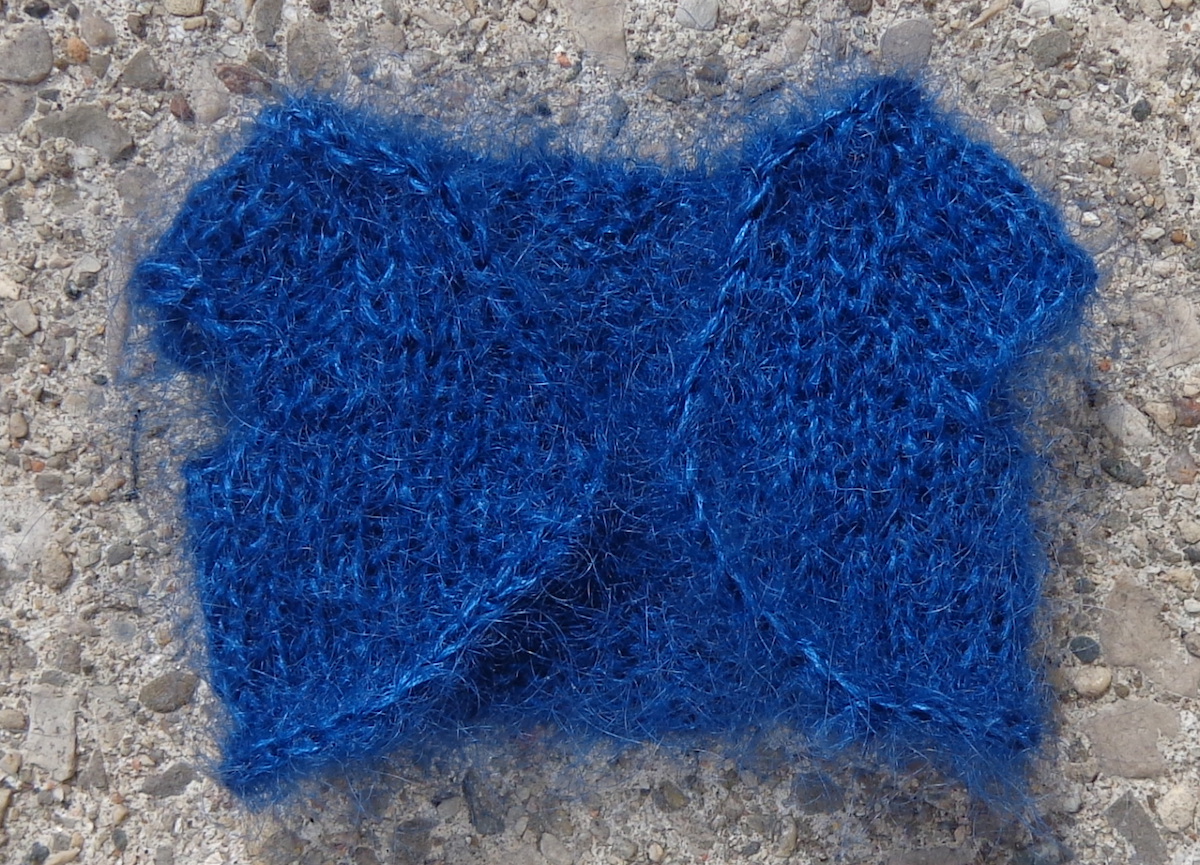
Jen has a Blythe doll and I knit this little shrug for her.

Shrug for Blythe knit by Deborah Cooke in Kidsilk Haze

This is extremely teeny and I wish I’d put something in the photograph for scale before sending it off. It’s maybe 2″ wide. The pattern is a free pattern on Ravelry called Shrug for Blythe, and it’s a great pattern. I found the instructions very clear and the results adorable – with no seaming! I knit it in some leftover Elann Silken Kydd, which is discontinued (that’s a Ravelry link) and a lot like Rowan Kidsilk Haze.

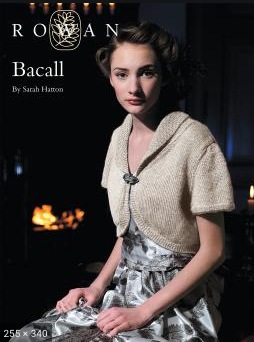
Bacall, a shrug pattern from Rowan designed by Sarah Hatton

I tried this sweater on Barbie, because I don’t collect Blythe dolls, and it was too small. The length was good and the back width, but the fronts were small. Barbie definitely has more of a bust than Blythe! I played around with the stitch counts and made a few more changes, too – I wanted a shrug king of like Bacall, a Rowan pattern for actual people. (The Rowan site has been redesigned and I’m not sure this pattern is even there anymore, so that’s a Ravelry link. It was originally published in Rowan 44, and was a free download for a while.)

This shrug was designed by Sarah Hatton – I think the sample garment is too broad in the shoulders for the model shown here (or maybe too wide in the neck), but I love the roll collar.

I knit the long-sleeved version of it in Kidsilk Aura for myself, and it’s a wonderful squishy soft warm sweater. (Yes, I actually used the specified yarn. It happens sometimes.)

Here’s my finished sweater and here’s my Ravelry project page.

Bacall by Sarah Hatton knit by Deborah Cooke in Rowan Kidsilk Aura

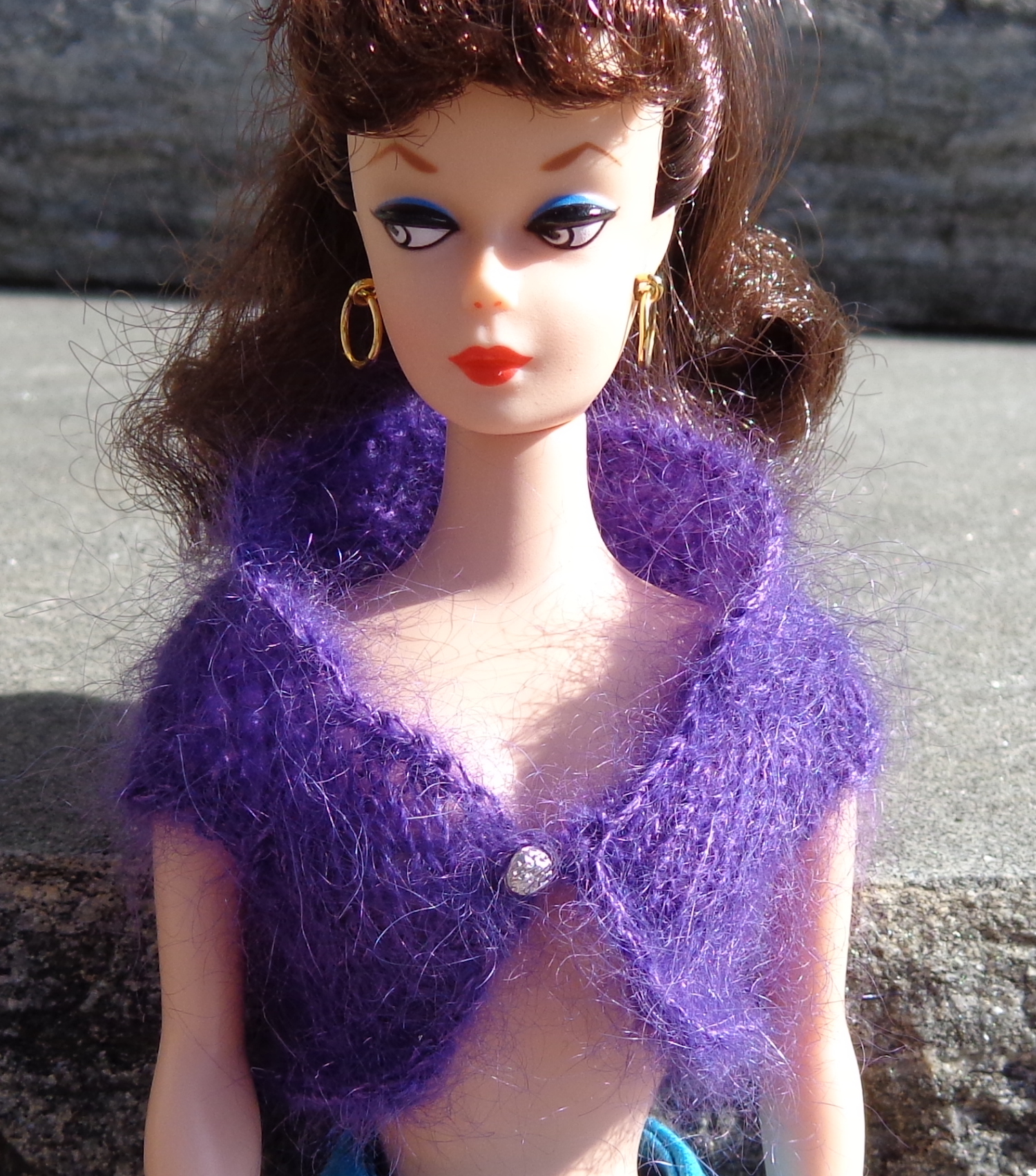
And here’s my modified shrug in Rowan Kidsilk Haze, adjusted to fit Barbie:

Shrug knit for Barbie by Deborah Cooke in Rowan Kidsilk Haze

It has cap sleeves and a garter stitch collar. There’s also a loop and button closure at the front. The collar can be rolled as above, or lifted so it makes an opera collar. See?

Shrug knit for Barbie by Deborah Cooke in Rowan Kidsilk Haze

My model, btw, is the 35th Anniversary Reproduction Barbie from 1993, the brunette version. I bought her on eBay NIB, and removed her from the box. (Yes, I am an un-boxer.) The plastic tie in her hair had disintegrated so I had to redo her hair, and the adhesive from her strapless bathing suit had also dried into a sticky mess, but I got her cleaned up. (I think she looks happier after 28 years in a box.) She’s a bit cheeky, wearing this shrug with nothing underneath, but she needs some tops and dresses. The Kidsilk Haze is really soft…

I still have a couple of tweaks to make to the pattern and will knit another one to be sure I have it right. (See how this goes?) Then she’ll need the perfect dress to wear with it…